



Rubber Machinery for Pharmaceutical Industry India — Medical Rubber Equipment
Laboratory mixing mills, hydraulic presses, and silicone-grade compound equipment for pharma stopper manufacturers, medical rubber goods producers, and ISO-certified rubber testing laboratories — from GIDC Umbergaon, Gujarat
Core Industries
Countries
Pharmaceutical & Medical Rubber — India's Fastest-Growing Precision Segment
India's pharmaceutical and medical devices sector is one of the fastest-growing manufacturing segments in the country. Behind every rubber stopper, syringe plunger, medical tube, diaphragm, and pharmaceutical seal is a rubber compounding and moulding process — and every step of that process requires precision rubber processing machinery.
Unlike general industrial rubber, pharmaceutical rubber manufacturing is governed by strict quality standards. Batch traceability, compound reproducibility, temperature accuracy, and contamination prevention are not optional — they are regulatory requirements. Modern Industries supplies machinery specifically configured for pharmaceutical-grade rubber processing: silicone-compatible mixing mills, PLC-controlled presses with data recording, and ISO QC-grade laboratory mills.
Machines Used in Pharmaceutical & Medical Rubber Manufacturing
Three primary machines serve pharmaceutical rubber production — each configured to pharma-grade requirements:

Laboratory Mixing Mill
- Model / Config
- Pharma Application
- Key Pharma Requirement
6"×13" to 8"×18" — Automatic model
Incoming raw material QC testing, compound formulation R&D, batch approval before production
Motorised nip + digital readout for ISO-grade batch reproducibility
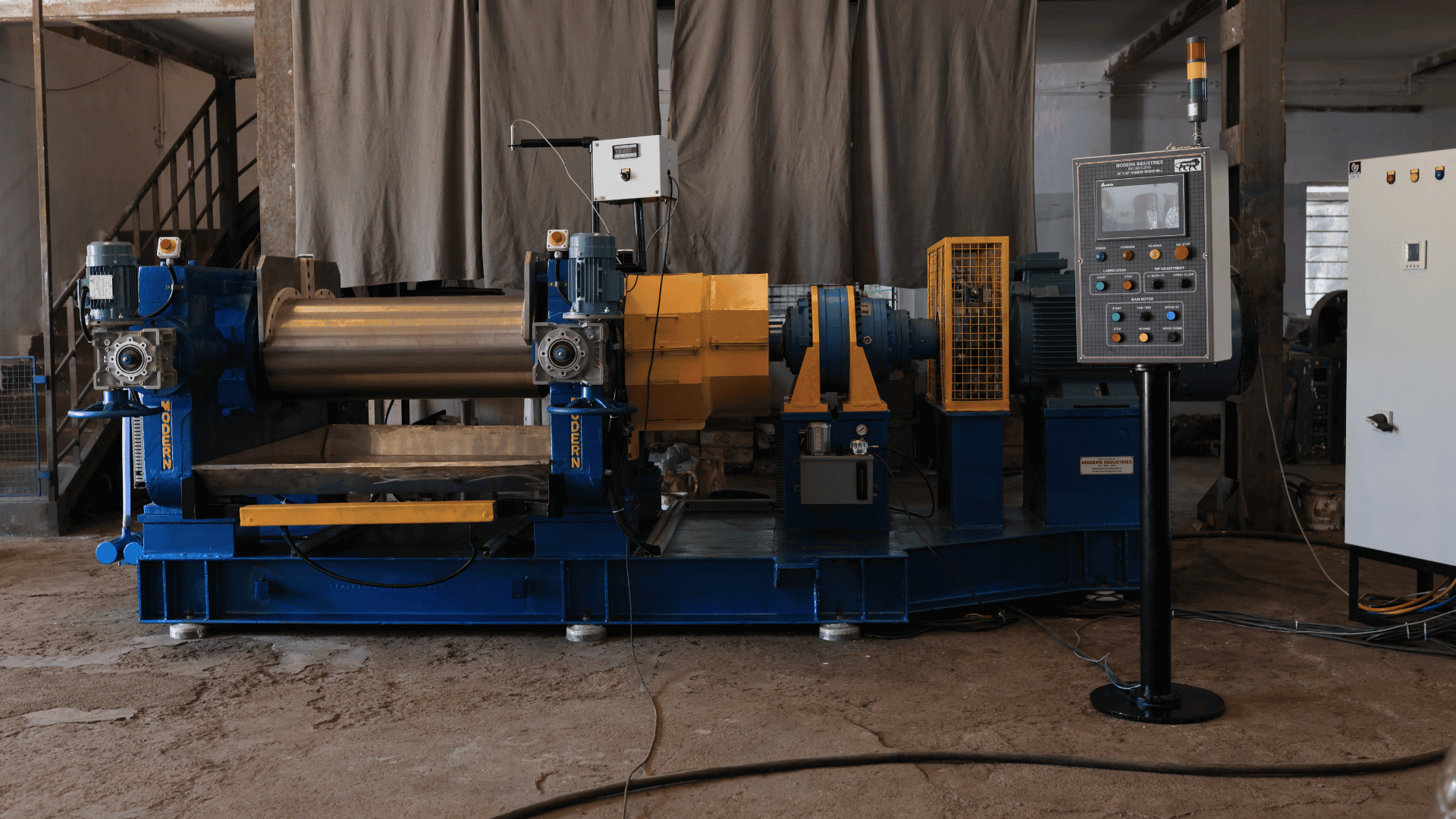
Rubber Mixing Mill (AFB)
- Model / Config
- Pharma Application
- Key Pharma Requirement
M3–M5 AFB — Silicone-grade config
Silicone rubber compound preparation for stoppers, tubing, and medical goods
Stainless steel roll option — prevents metal contamination in pharma compounds
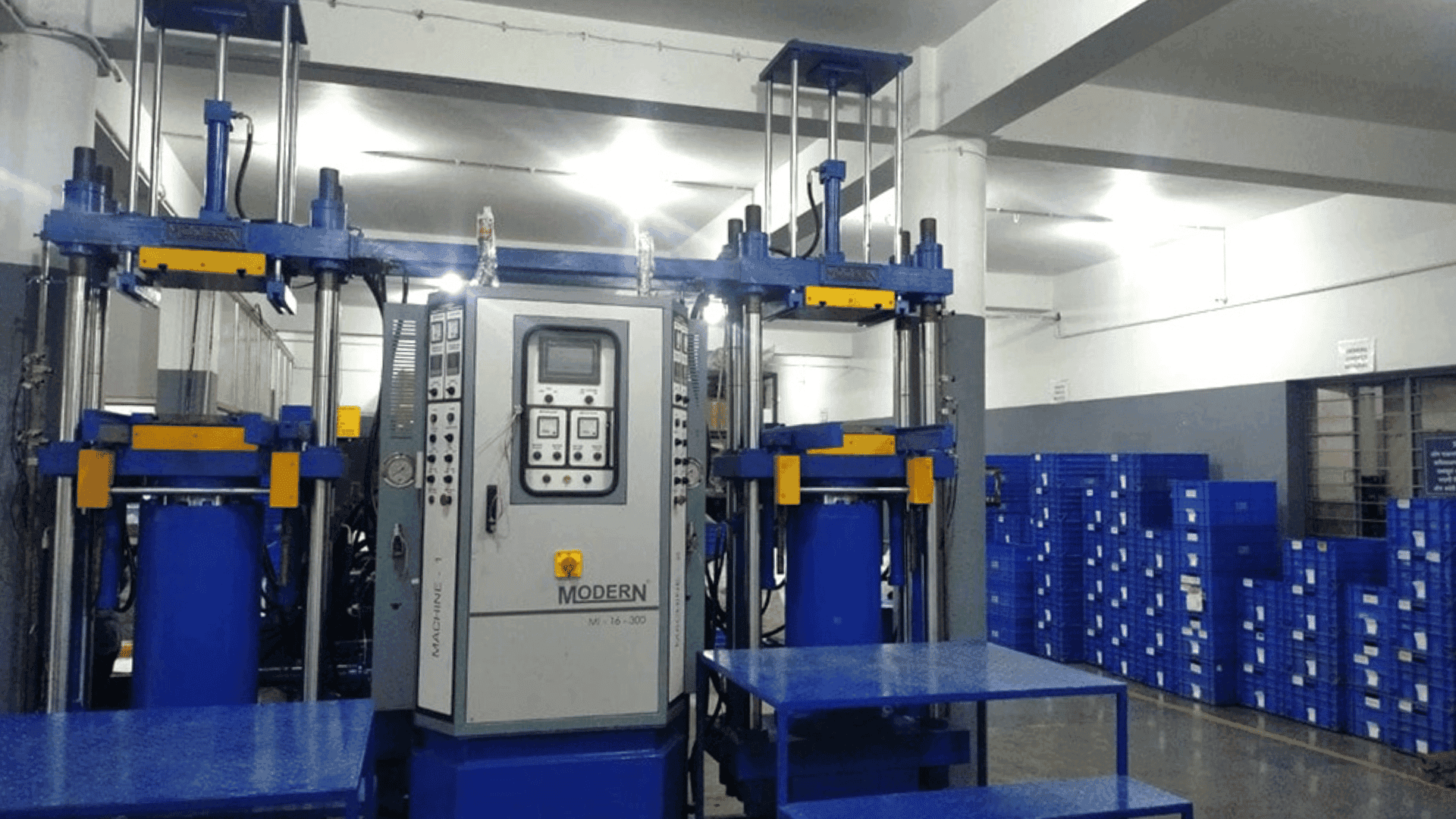
Hydraulic Press
- Model / Config
- Pharma Application
- Key Pharma Requirement
MI-HP-12 to MI-HP-20 (37T–200T)
Compression moulding of stoppers, plugs, diaphragms, septa, and valve seals
PLC cure cycle + data recording for regulatory traceability and customer audit
Laboratory Mixing Mill for Pharmaceutical Rubber Testing
The laboratory mixing mill is the most critical machine in a pharmaceutical rubber QC operation. Every batch of incoming raw rubber — natural, silicone, EPDM — is tested on the lab mill before being cleared for production. A compound batch is prepared, sheeted, and tested for hardness, elongation, and extractable content against the approved specification.
Modern Industries laboratory mixing mills in the 6"×13" to 8"×18" range are available in the Automatic configuration with motorised nip adjustment, digital nip gap readout, and TCU-integrated temperature control. This configuration meets the ISO QC lab requirement for identical physical parameters on every test batch — independent of operator or shift.
- Motorised nip with digital readout — batch-to-batch nip gap reproducibility to 0.01 mm
- TCU temperature control to ±1°C — essential for thermally sensitive pharma compound testing
- Fully Automatic configuration — consistent process parameters regardless of operator
- Stainless steel roll option — for silicone compound testing without metal contamination
Pharmaceutical Rubber Manufacturing Process
Step 1 — Incoming Material Testing
Step 2 — Compound Preparation
Step 3 — Component Moulding
Step 4 — Quality Verification & Batch Record
Silicone Rubber Processing for Medical Grade Products
Silicone rubber is the material of choice for medical tubing, peristaltic pump tubes, medical stoppers, and implant-adjacent components. Silicone processing has specific machinery requirements that differ from conventional rubber:
- Stainless steel contact surfaces — silicone is chemically reactive with carbon steel and can pick up metal contamination that disqualifies the compound for medical use
- Low-shear mixing — silicone degrades under excessive shear. The mixing mill friction ratio and roll speed must be set lower than for conventional rubber compounds
- Clean-room compatible design — silicone compound areas in pharma factories require dust-free machinery surfaces and easy-clean roll configuration
- Silicone extruder for tubing — continuous silicone profiles and medical tubing are produced on dedicated silicone extruders, not mixing mills
Modern Industries supplies silicone-grade mixing mill configurations with stainless steel rolls as standard for pharma and medical applications, and silicone extruders for tubing and profile extrusion.
Why Pharmaceutical Rubber Manufacturers Choose Modern Industries
- Laboratory Mixing Mill with motorised nip and digital readout — ISO-grade batch reproducibility that meets the incoming material testing protocols of regulated pharmaceutical manufacturers
- Stainless steel roll option on AFB mixing mills — the only correct configuration for silicone and pharma-grade compound processing where metal contamination must be prevented
- PLC-controlled hydraulic press with data recording — batch traceability documentation for every cure cycle meets regulatory and customer quality audit requirements
- TCU temperature control to ±1°C — consistent roll temperature across the full mix cycle for thermally sensitive pharmaceutical compound formulations
- Four lab mill configurations (Standard, Uni-Drive, Independent Drive, Automatic) — the right capability level for every pharma application from academic R&D through to ISO production QC
Frequently Asked Questions — Pharmaceutical & Medical Rubber Machinery
What laboratory mill configuration is recommended for pharmaceutical rubber QC?
The 8″×18″ Automatic Laboratory Mixing Mill with motorised nip adjustment, digital gap display, and TCU temperature control is the recommended configuration for ISO-certified pharmaceutical rubber QC labs. Motorised nip ensures identical parameters on every test batch — essential for incoming material testing and compound batch approval in regulated manufacturing environments.
Can Modern Industries mixing mills process silicone rubber?
Yes. Modern Industries offers silicone-grade Mixing Mill (AFB Series) configurations with stainless steel roll surfaces and specialised sealing. Stainless steel contact surfaces prevent metal ion contamination in silicone compounds — a requirement for pharmaceutical and medical-grade silicone processing. For extruded silicone tubing and profiles, a dedicated silicone extruder is also available.
What hydraulic press specification is required for rubber stopper moulding?
Pharmaceutical rubber stopper moulding typically uses presses in the 37T–150T range with small platens (300×300 mm to 460×460 mm) and electric heating for precise temperature control. The MI-HP-12 (37T) to MI-HP-18 (150T) range covers the stopper and diaphragm moulding envelope. PLC-controlled cure cycles with data recording are essential for pharma regulatory requirements.
How does PLC data recording on the hydraulic press support pharmaceutical compliance?
The PLC on Modern Industries MI-HP presses records cure parameters — pressure, temperature, and cure time — for every batch. This log provides the traceability documentation required by pharmaceutical customers for their supplier quality audits and by regulatory agencies for manufacturing process validation. Batch records can be exported for inclusion in product quality documentation.
Can Modern Industries machinery meet FDA compliance requirements for rubber products?
Modern Industries supplies the machinery — the FDA compliance of the rubber product depends on the compound formulation, process validation, and quality system of the manufacturer. However, our PLC-controlled presses with cure data recording, temperature-accurate platens, and stainless steel roll mixing mills provide the process control capabilities required to support FDA-compliant manufacturing processes for rubber goods.