


Rubber Sheet Making Machine Manufacturer India — Calender Machine & Mixing Mill
Calender machines and mixing mills for rubber sheet and mat manufacturers — industrial anti-skid mats, rubber flooring, hospital sheets, slipper sole blanks, and rubber linings. Supplied from GIDC Umbergaon, Gujarat.
Core Industries
Countries
Rubber Sheet & Mat Manufacturing — Calender Machine is the Core Machine
A rubber sheet making machine is, at its core, a calender machine — a precision roll machine that passes compounded rubber between two or more temperature-controlled rolls to produce a continuous, flat rubber sheet at a precisely controlled thickness.
Rubber sheets and mats are produced across a wide range of industries and applications: industrial safety mats, anti-skid flooring for factories and warehouses, hospital rubber sheets, insulating rubber sheeting, footwear sole blanks, conveyor belt covers, and rubber lining for chemical tanks. Every application requires a specific sheet thickness, compound specification, and width — all of which are controlled by the calender machine and the mixing mill upstream.
Modern Industries manufactures the MI-CL Series calender machines — available from the MI-CL-8x24 (21" width, 15 HP) to the MI-CL-24x72 (69" width, 250 HP) — and the AFB Series Rubber Mixing Mills for upstream compound preparation.
Machines Used for Rubber Sheet & Mat Manufacturing
MI-CL-8×24 to MI-CL-24×72
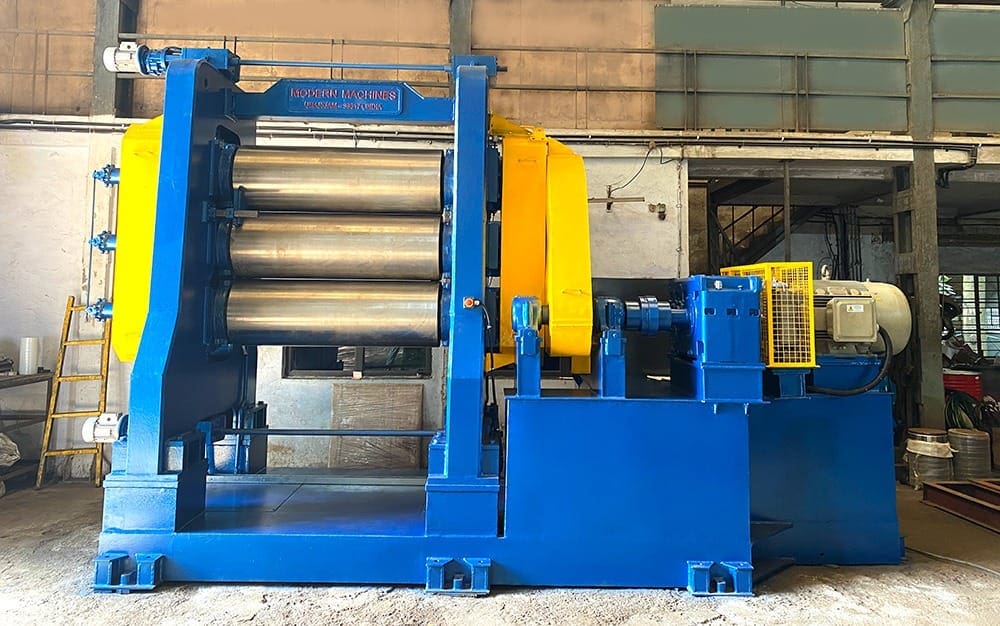
Calender Machine
Role in Sheet & Mat Production: Sheets compound into uniform flat rubber sheet at controlled thickness — the primary sheet making machine
Recommended for: All rubber sheet and mat production. Width and HP selected by required sheet width.
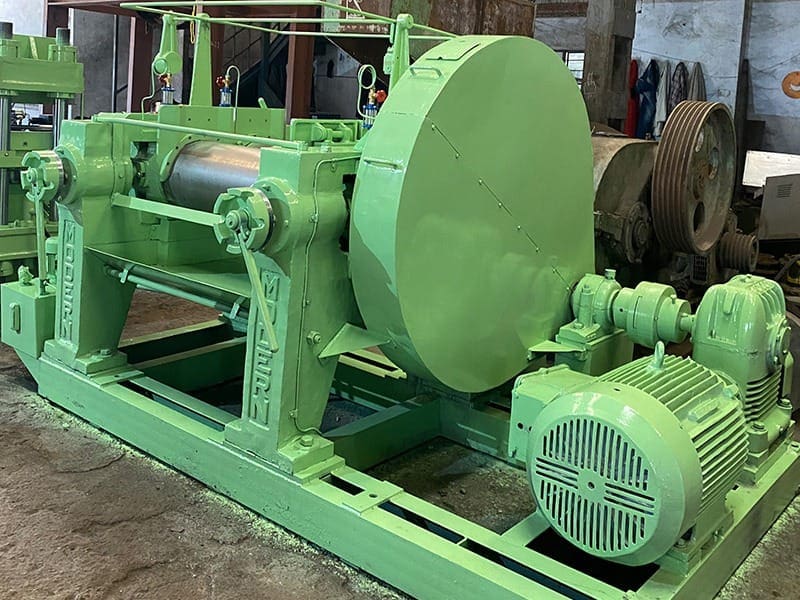
Rubber Mixing Mill
Role in Sheet & Mat Production: Prepares the rubber compound — mixes SBR, NR, or EPDM with fillers, pigments, and cure system before calendering
Recommended for: Upstream Upstream compound prep for all sheet types. Hydraulic stock blender speeds colour mixing.
MI-HP-24 to MI-HP-48
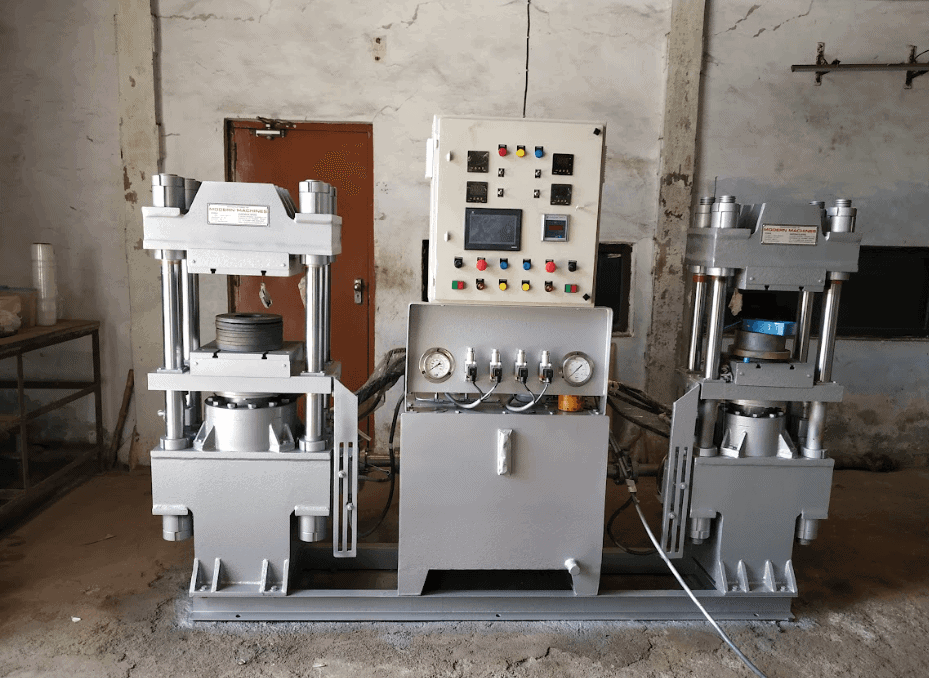
Hydraulic Press
Role in Sheet & Mat Production: Compression moulding of patterned rubber mats with embossed or textured surface designs
Recommended for: Anti-skid mats, chequered flooring tiles, and patterned industrial mats requiring surface texture
Rubber Sheet Manufacturing Process — From Compound to Finished Sheet
Step 1 — Compound Preparation
The rubber compound — SBR, NR, EPDM, or NBR depending on the sheet specification — is prepared on the Mixing Mill (M3–M6 AFB). Fillers, colour pigments, plasticisers, and the cure system are incorporated. The hydraulic stock blender standard on all AFB mills assists in uniform colour dispersion — critical for black industrial mats and for coloured floor tiles where shade consistency across batches is a quality requirement.
Step 2 — Calendering to Sheet
The compounded rubber is fed into the Calender Machine (MI-CL Series) between the heated, precision-ground rolls. The nip gap — set by the motorised nip adjustment — determines the sheet thickness. Typical sheet thicknesses range from 1 mm (thin insulating sheets) to 20 mm (thick industrial mats and conveyor belt covers).
The calender's crown-compensated rolls ensure uniform sheet thickness across the full working width — preventing the thicker-edge, thinner-centre profile that uncorrected roll deflection would produce. Digital nip gap indicators allow the operator to monitor and adjust thickness in real time without stopping the line.
Step 3 — Cooling & Sheet Collection
The hot rubber sheet exiting the calender is cooled by passing over cooling drums or through a water-cooled conveyor section. The wind-up unit integrated with the MI-CL calender collects the cooled sheet on to a roll under controlled tension — preventing sheet stretching or gauge variation during winding.
Step 4 — Cutting & Finishing (Mats & Tiles)
For rubber floor tiles and mats, the calendered sheet is cut to size — either by guillotine cutters for plain sheets or by hydraulic die-cut presses for shaped mat outlines. Embossed and patterned anti-skid surfaces are typically produced by compression moulding the pre-cut blanks in the Hydraulic Press (MI-HP-24 to MI-HP-48) using a patterned mould tool.
Rubber Sheet & Mat Types — Machine Selection Guide
Industrial anti-skid mat
Thickness: 6–15 mm
Rubber Compound: SBR or NR
Primary Machine: Calender + Press (for pattern)
Notes: Chequered or coin-stud pattern via hydraulic press mould
Rubber flooring tile
Thickness: 3–10 mm
Rubber Compound: SBR
Primary Machine: Calender Machine
Notes: Plain or textured — cut from calendered sheet
Hospital / operating theatre sheet
Thickness: 2–4 mm
Rubber Compound: Natural rubber
Primary Machine: Calender Machine
Notes: Smooth, low-extractable compound for healthcare use
Electrical insulating sheet
Thickness: 1–6 mm
Rubber Compound: NR (high purity)
Primary Machine: Calender Machine
Notes: ISI/BIS grade compound, certified dielectric properties
Footwear sole blank
Thickness: 4–8 mm
Rubber Compound: SBR/EVA/NR
Primary Machine: Calender Machine
Notes: Cut into blanks before hydraulic press moulding
Conveyor belt cover sheet
Thickness: 3–20 mm
Rubber Compound: SBR or NR
Primary Machine: Calender Machine
Notes: Wide-format calendering — MI-CL-18x54 or MI-CL-24x72
Chemical tank rubber lining
Thickness: 3–6 mm
Rubber Compound: EPDM or NR
Primary Machine: Calender Machine
Notes: Wide, void-free sheet critical for lining adhesion
Rubber gasket sheet (cut-to-size)
Thickness: 1–6 mm
Rubber Compound: NBR or EPDM
Primary Machine: Calender Machine
Notes: Blanks cut to gasket outline by die press after calendering
Calender Machine Selection — Sheet Width & Motor Power
Select the right MI-CL calender model based on your required sheet width and production output:
MI-CL-8x24
Max Sheet Width: 21" (533 mm)
Motor Power: 15 HP
Best Application: Small-format sheet, lab sheet testing, footwear sole blanks
MI-CL-10x30
Max Sheet Width: 27" (686 mm)
Motor Power: 20 HP
Best Application: Medium-width industrial mats, footwear sheets
MI-CL-14x42
Max Sheet Width: 39" (991 mm)
Motor Power: 40 HP
Best Application: Standard industrial mat production, floor tiles, general sheet
MI-CL-18x54
Max Sheet Width: 51" (1,295 mm)
Motor Power: 75 HP
Best Application: Wide-format flooring tiles, hospital sheets, conveyor belt cover
MI-CL-24x72
Max Sheet Width: 69" (1,753 mm)
Motor Power: 250 HP
Best Application: Full-width conveyor belt covers, tank lining, large-format mats
Why Sheet & Mat Manufacturers Choose Modern Industries
- Crown-compensated, precision-ground calender rolls on all MI-CL models — uniform sheet thickness across the full working width, batch after batch. Essential for anti-skid mat and flooring tile production where gauge consistency determines product quality
- Motorised nip adjustment with digital readout — operator can monitor and correct sheet thickness in real time without stopping the line. Reduces waste on gauge rejection during production runs
- Integrated wind-up unit with tension control — consistent sheet roll winding prevents gauge variation and sheet distortion that makes downstream cutting inaccurate
- Hydraulic stock blender on all AFB mixing mills — fast, uniform colour pigment dispersion in coloured mat and flooring tile compounds reduces batch-to-batch colour variation
- Complete line from one supplier — Mixing Mill (AFB) + Calender (MI-CL) + optional Hydraulic Press (MI-HP) for patterned mats — all machines from Modern Industries, ensuring compatibility and single-point after-sales service
Frequently Asked Questions — Rubber Sheet & Mat Making Machines
What machine is used to make rubber sheets?
A rubber sheet making machine is a calender machine — a precision roll machine that passes compounded rubber between two or more heated rolls at a controlled nip gap to produce a flat rubber sheet at a uniform thickness. Modern Industries manufactures the MI-CL Series calender machines in widths from 21″ (MI-CL-8×24) to 69″ (MI-CL-24×72). An upstream Rubber Mixing Mill (AFB Series) is used to prepare the rubber compound before calendering.
What is the difference between a rubber sheet and a rubber mat?
A rubber sheet is a flat continuous output from the calender machine — typically wound on a roll and later cut to size. A rubber mat is typically a finished product of defined dimensions, often with a patterned or embossed surface. Plain rubber mats are cut directly from calendered sheets. Patterned anti-skid mats are produced by compression moulding pre-cut sheet blanks in a hydraulic press with a patterned mould.
What thickness of rubber sheet can a calender machine produce?
Modern Industries MI-CL calender machines can produce rubber sheets from approximately 1 mm (thin electrical insulating sheet) to 20 mm (thick conveyor belt cover or heavy industrial mat). Sheet thickness is set by the nip gap — adjusted by the motorised nip control. Digital nip gap indicators allow real-time monitoring. For sheets thicker than 15 mm, multiple calender passes or compression moulding are typically more suitable than a single-pass calender.
What rubber compound is used for anti-skid rubber mats?
Anti-skid rubber mats are typically made from SBR (styrene-butadiene rubber) or an NR/SBR blend — compounded with carbon black for reinforcement, a cure system, and optional colour pigments. SBR provides good abrasion resistance and ageing properties for factory and warehouse floor mat applications. The compound is prepared on a Mixing Mill (M3–M5 AFB) and then calendered to the required mat blank thickness before press moulding with the anti-skid pattern.
Can the same calender machine produce both footwear sheets and industrial mats?
Yes. A single MI-CL calender machine can produce rubber sheets for multiple applications by changing the nip gap setting and roll temperature. The MI-CL-14×42 (39″ width, 40 HP), for example, is commonly used in factories that produce both footwear sole blanks (4–6 mm) and industrial anti-skid mat blanks (8–12 mm) on the same machine across different production runs.