



Rubber Rollers — Manufacturing Machine Manufacturer India
Mixing mills, hydraulic presses, and grinding machines for rubber roller manufacturers — printing rollers, textile rollers, rice mill rubber rollers, paper mill rollers, and industrial rubber-covered rollers. Supplied from GIDC Umbergaon, Gujarat.
Core Industries
Countries
Rubber Rollers — India's Most Widely Used Industrial Component
Rubber rollers are among the most widely used industrial components in India. Virtually every manufacturing industry that processes a material in sheet, web, or continuous form uses rubber rollers to drive, guide, nip, coat, or apply pressure to that material as it passes through the production line.
From printing presses and textile ring frames to rice hulling machines, paper mills, and agricultural equipment — rubber rollers are present at the core of the production process. India has a large and active rubber roller manufacturing industry serving all these segments, concentrated in Tamil Nadu, Gujarat, Maharashtra, and Punjab.
Modern Industries supplies the machinery that rubber roller manufacturers use to compound, mould, build, and finish rubber rollers — the Rubber Mixing Mill for compound preparation, the Hydraulic Press for moulding and bonding the rubber to the metal core, and Grinding Machines for final dimensional finishing.
Machines Used in Rubber Roller Manufacturing
Three primary machines are used in rubber roller production:
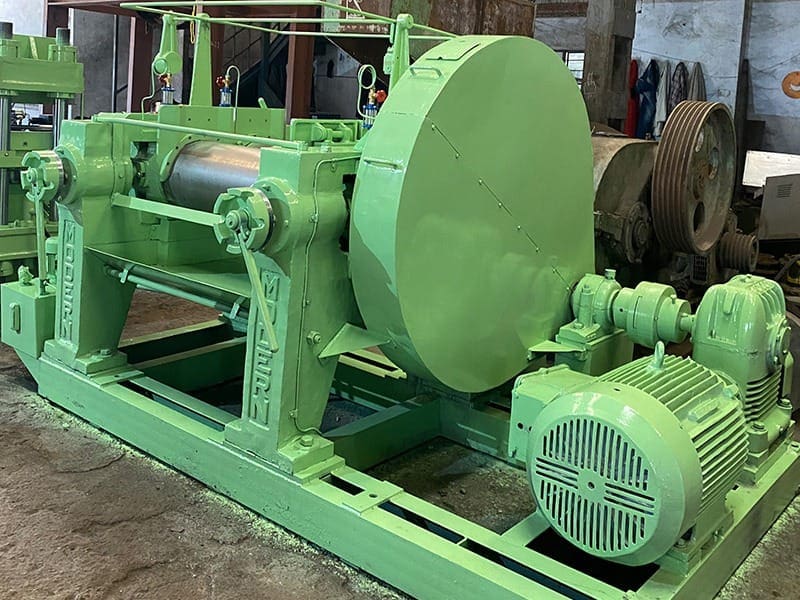
Rubber Mixing Mill
Role in Roller Manufacturing: Prepares the rubber compound — mixed with carbon black, fillers, and cure system to achieve the required Shore hardness specification
Key Specification: Hydraulic nip adjustment maintains compound sheet gauge for consistent roller building layer thickness
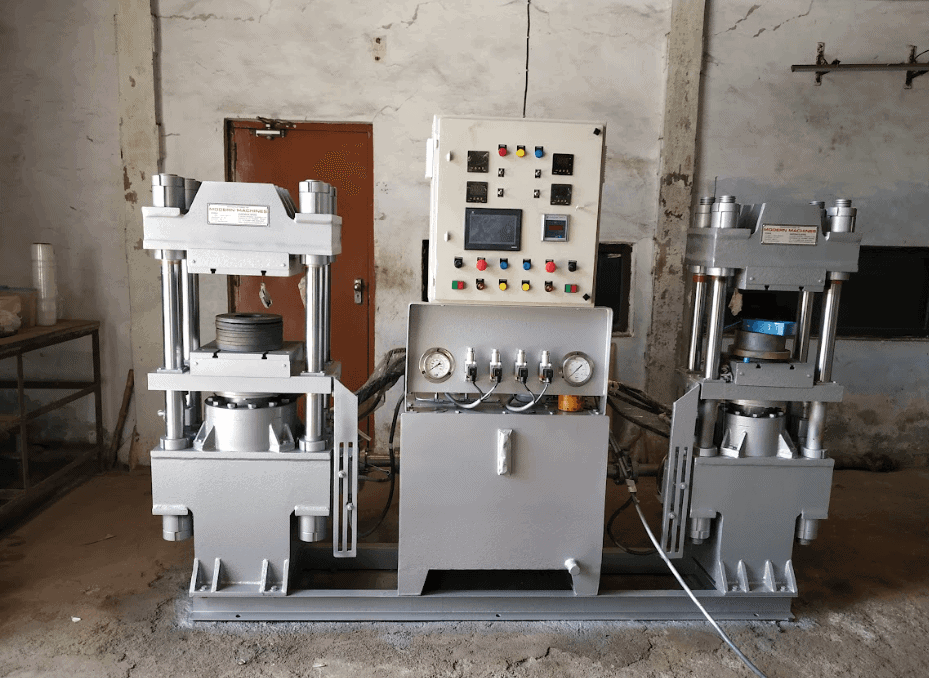
Hydraulic Press
Role in Roller Manufacturing: Bonds rubber to metal core under heat and pressure — vulcanises the rubber layer and develops adhesion to the bonded core
Key Specification: PLC-controlled cure cycle ensures consistent bond strength and rubber hardness across every roller
Centreless / Cylindrical

Grinding Machine
Role in Roller Manufacturing: Grinds cured rubber roller to final diameter, TIR (Total Indicated Runout), and surface finish specification
Key Specification: Achieves micron-level dimensional accuracy — critical for printing and textile precision rollers
Rubber Roller Manufacturing Process
Step 1 — Core Preparation
The metal core — typically mild steel, stainless steel, or aluminium — is cleaned, shot-blasted, and coated with a rubber-to-metal bonding agent (adhesive primer). The bonding agent creates a chemical bridge between the metal surface and the rubber compound — critical for long roller service life under dynamic loading.
Step 2 — Compound Preparation
The rubber compound is prepared on the Mixing Mill (M3–M6 AFB). The compound specification — rubber type, Shore hardness, filler loading, and cure system — is formulated to the end-use requirements of the roller. Printing roller compound requires different hardness and surface characteristics than a rice mill dehuller roller or a textile drafting roller.
The compound is sheeted to a strip or slab thickness suitable for wrapping or pressing onto the metal core.
Step 3 — Rubber Building
The compounded rubber is applied to the prepared metal core in one of two ways: strip winding (wrapping a continuous rubber strip in overlapping helical layers around the rotating core until the required diameter build-up is achieved) or mould pressing (placing the core inside a cylindrical mould and pressing compound around it in the Hydraulic Press). The mould pressing method is preferred for precision rollers where dimensional control is critical.
Step 4 — Vulcanising (Hydraulic Press)
The rubber-built core is placed in the Hydraulic Press (MI-HP Series) inside a steel mould. The PLC-controlled press closes at the programmed pressure, temperature, and cure time — vulcanising the rubber compound and developing the adhesive bond between rubber and metal core. The cure cycle determines the final hardness, resilience, and surface characteristics of the roller.
Step 5 — Grinding to Final Dimension
After vulcanising, the roller is mounted between centres on a Grinding Machine and ground to the final specified diameter, Total Indicated Runout (TIR), and surface finish. For precision rollers — printing, textile, and paper mill — TIR tolerances of 0.02–0.05 mm are required. For general industrial rollers, looser tolerances apply. Surface texture (smooth, grit, knurled) is applied in the grinding or polishing stage.
Rubber Rollers by Industry — Types and Compound Requirements
Rubber Rollers for Printing Industry
Printing rubber rollers — ink distribution rollers, form rollers, impression rollers, and dampening rollers — require precisely controlled Shore hardness (typically 20–40 Shore A for offset printing), smooth surface finish, solvent resistance, and excellent resilience for ink transfer without smearing.
The compound is typically based on NBR (nitrile rubber) or EPDM — providing resistance to the printing inks, fountain solutions, and wash-up solvents used in offset and flexographic printing. Roller diameter and TIR tolerances are tight — typically 0.02–0.04 mm — requiring precision grinding after vulcanising.
Rubber Rollers for Textile Industry
Textile rubber rollers serve multiple functions in spinning, weaving, and processing machinery: bottom draft rollers in ring spinning frames, pressure rollers in drawing and roving frames, delivery rollers in speed frames, and calender rollers in fabric finishing. Each position requires a specific compound hardness, surface finish, and dimensional accuracy.
Textile rollers are typically produced from NR (natural rubber) or SBR compounds in 60–80 Shore A hardness. Precision grinding is essential — even small TIR variations cause uneven draft in the spinning process, leading to yarn count variation and fabric defects.
Rubber Rollers for Rice Milling
The rubber roller is the core component of every rice huller machine. Two rubber rollers running at differential speeds dehusk paddy rice by squeezing and shearing the husk from the grain. The rubber must provide the right combination of hardness (75–85 Shore A), resilience, and abrasion resistance to remove husks efficiently without breaking rice grains.
Rice mill rubber rollers are one of the highest-volume rubber roller segments in India — every rice processing mill in the country uses them, and they are consumable components replaced regularly. Compound preparation on the Mixing Mill and pressing in the Hydraulic Press are the two primary production operations for rice mill roller manufacturers.
Rubber Rollers for Paper Mill
Paper mill rubber rollers — press section rollers, coater rollers, calendar rollers, and guide rollers — operate in a wet, abrasive environment under continuous high nip loads. The compound must resist water absorption, maintain hardness stability under temperature variation, and provide the surface properties required for paper formation, pressing, and calendering.
Paper mill rollers are typically large in diameter (200–800 mm) and long in face width (up to 8,000 mm for wide paper machines). The rubber compound is applied in thick layers — 15–30 mm — and cured in large-diameter hydraulic presses. Modern Industries' large-platen presses (MI-HP-36 to MI-HP-48, 500T–600T) are well-suited for the curing stage of medium and large paper mill rollers.
Industrial & Agricultural Rubber Rollers
Beyond the four major segments above, rubber rollers are used across a wide range of industrial and agricultural applications: feed rollers in grain and seed processing, laminating rollers in plywood and veneer production, transfer rollers in coating and painting lines, traction rollers in cable and wire drawing, and drive rollers in conveyor and material handling systems. Most industrial rollers are produced from SBR, EPDM, or NR compounds in 40–70 Shore A hardness range.
Hydraulic Press Selection for Rubber Roller Curing
Press selection for rubber roller curing depends on roller diameter and face width. The press mould must accommodate the roller OD and face length with sufficient daylight clearance.
Printing rollers
Typical Roller OD: 50–200 mm
Face Width: 300–1,200 mm
Recommended Press: MI-HP-14 to MI-HP-24
Tonnage: 65T–250T
Textile draft rollers
Typical Roller OD: 25–80 mm
Face Width: 200–500 mm
Recommended Press: MI-HP-12 to MI-HP-16
Tonnage: 37T–100T
Rice mill rubber rollers
Typical Roller OD: 100–200 mm
Face Width: 250–350 mm
Recommended Press: MI-HP-16 to MI-HP-20
Tonnage: 100T–200T
Paper mill press rollers
Typical Roller OD: 300–800 mm
Face Width: 1,000–8,000 mm
Recommended Press: MI-HP-36 to MI-HP-48
Tonnage: 500T–600T
Industrial drive rollers
Typical Roller OD: 100–400 mm
Face Width: 500–2,000 mm
Recommended Press: MI-HP-24 to MI-HP-36
Tonnage: 250T–500T
Agricultural feed rollers
Typical Roller OD: 80–150 mm
Face Width: 300–600 mm
Recommended Press: MI-HP-16 to MI-HP-22
Tonnage: 100T–200T
Why Rubber Roller Manufacturers Choose Modern Industries
- PLC-controlled hydraulic press with precise temperature and pressure control — consistent rubber hardness and bond strength across every roller in a production batch. Critical for precision printing and textile rollers where Shore hardness variation causes performance inconsistency
- Complete machine compatibility — Mixing Mill (compound prep) + Hydraulic Press (vulcanising) from one manufacturer. Machine specifications are matched so compound output from the mill directly suits press feeding without intermediate handling adjustments
- Wide press range from 37T (MI-HP-12) to 600T (MI-HP-48) — covers the full roller size range from small textile draft rollers to large industrial and paper mill rollers without requiring a different press supplier
- AFB Mixing Mill with hydraulic nip adjustment — consistent compound strip gauge for uniform layer-by-layer roller building, reducing the number of moulding rejects due to uneven rubber thickness before pressing
- 50 years of rubber machinery manufacturing — after-sales service, spare parts, and engineering support across India and 19+ export countries. Roller manufacturers in Gujarat, Tamil Nadu, and Punjab have reference installations
Frequently Asked Questions — Rubber Roller Manufacturing Machinery
What machines are needed to manufacture rubber rollers?
Three machines are used in rubber roller manufacturing: (1) a Rubber Mixing Mill (AFB Series) to prepare the rubber compound to the required hardness specification, (2) a Hydraulic Press (MI-HP Series) to vulcanise the rubber onto the metal core under controlled heat and pressure, and (3) a Grinding Machine to finish the roller to the specified diameter, TIR, and surface finish. Modern Industries supplies the Mixing Mill and Hydraulic Press from this set.
What rubber compound is used for rice mill rollers?
Rice mill rubber rollers are typically made from NR (natural rubber) or NR/SBR blends in 75–85 Shore A hardness. The compound must balance hardness (to dehusk efficiently), resilience (to avoid cracking), and abrasion resistance (to maximise roller life before replacement). The compound is prepared on a Mixing Mill (M3–M5 AFB) and the roller is vulcanised in a Hydraulic Press (MI-HP-16 to MI-HP-20, 100T–200T).
What hardness rubber is used for printing rollers?
Printing rubber rollers typically use 20–40 Shore A hardness for offset printing (soft for ink transfer without smearing) and 40–60 Shore A for flexographic printing and pressure rollers. NBR (nitrile) is the most common compound for ink rollers due to its solvent and ink resistance. Precise hardness control during compound preparation on the Mixing Mill is critical — Shore hardness variation of even 3–5 points affects ink distribution quality.
What is the TIR requirement for rubber rollers?
TIR (Total Indicated Runout) is the measure of dimensional accuracy — how true the roller runs on its axis. Printing rollers require TIR of 0.02–0.04 mm. Textile draft rollers require 0.02–0.05 mm. Rice mill rollers tolerate 0.1–0.2 mm. Industrial and conveyor rollers may accept 0.2–0.5 mm. TIR is achieved by precision grinding on a cylindrical grinding machine after vulcanising. The press cure quality (uniform rubber density) directly affects how accurately the roller can be ground to spec.
Can Modern Industries supply machinery for rubber roller re-rubbering?
Yes. Re-rubbering (or rubber recovering) is the process of stripping worn rubber from an existing metal core and applying fresh rubber. The same Mixing Mill and Hydraulic Press used for new roller production are used for re-rubbering. The metal core must be cleaned and re-primed with bonding agent before fresh compound is applied. Modern Industries machinery is well-suited for roller manufacturers who offer re-rubbering services alongside new roller production.