



Rubber Cots & Aprons Machine India — Spinning Frame Rubber Components
Mixing mills, hydraulic presses, and grinding machines for rubber cots and aprons manufacturers — spinning frame top roller cots, drafting aprons, and ring frame rubber components. Supplied to Coimbatore, Surat, Ludhiana, and Ahmedabad textile clusters from GIDC Umbergaon, Gujarat.
Core Industries
Countries
Rubber Cots & Aprons — The Essential Consumable in India's Textile Industry
India is one of the world's largest producers of cotton and synthetic yarn — with over 50 million ring spindles operating across spinning mills in Tamil Nadu, Gujarat, Maharashtra, Punjab, and Rajasthan. Every one of those spindles has top rollers fitted with rubber cots — cylindrical rubber sleeves that create the nipping surface in the drafting zone of the ring frame. Every drafting zone also uses rubber aprons — flat rubber belts that carry the fibre sliver through the drafting sequence.
Rubber cots and aprons are consumable components. They wear, harden, and lose their grip over time — and must be replaced or re-ground every 1–3 years depending on yarn type and production conditions. This makes cots and aprons one of the highest-frequency repeat-purchase rubber products in the Indian textile machinery ecosystem.
The machinery used to manufacture rubber cots and aprons — Mixing Mills, Hydraulic Presses, and Grinding Machines — is specialist equipment for this segment. Modern Industries supplies the Mixing Mill and Hydraulic Press from this set, manufactured at GIDC Umbergaon, Gujarat.
What Are Rubber Cots and Aprons?
Rubber Cots (Top Roller Cots)
A rubber cot is a cylindrical rubber sleeve pressed onto the top roller arm in a ring spinning frame, speed frame, or draw frame. It works with the fluted steel bottom roller to draft (thin out) the fibre bundle by gripping and controlling fibre flow through differential speed drafting.
The rubber cot must provide:
- Correct Shore hardness — typically 60–80 Shore A, adjusted per yarn count and fibre type
- Uniform cylindricity — any runout or taper causes uneven fibre nipping and yarn count variation
- Smooth, consistent surface finish — rough or pitted surface creates fibre accumulation and nep formation
- Low compression set — the cot must recover its shape after nip pressure and not permanently deform
Rubber Aprons (Drafting Aprons)
A rubber apron is a flat, continuous rubber belt that wraps around a cradle in the drafting zone of a ring frame, speed frame, or roving frame. The apron carries the fibre sliver forward under controlled tension — preventing fibre floating and maintaining even fibre distribution during high-draft spinning. Aprons must have consistent thickness, uniform hardness, and excellent flex fatigue resistance — they run continuously under tension around a small-radius cradle at high speed.
Machines Used for Rubber Cots & Aprons Manufacturing
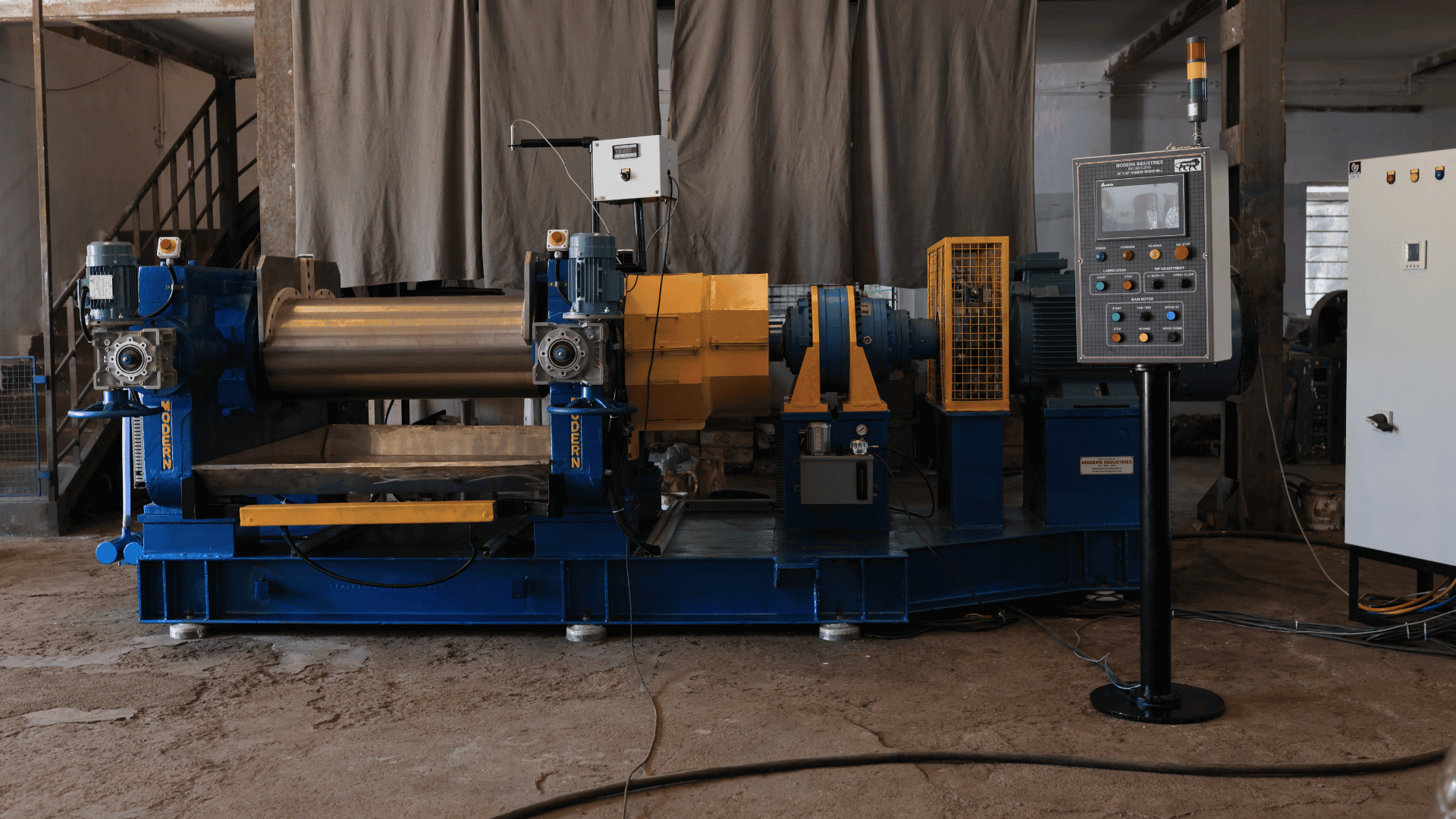
- Model / Series
- Application
- Key Requirement
M3–M5 AFB
Compound preparation — NR or NR/SBR blend to precise Shore hardness specification
Consistent compound gauge strip for uniform cot layer thickness. Hydraulic nip standard.
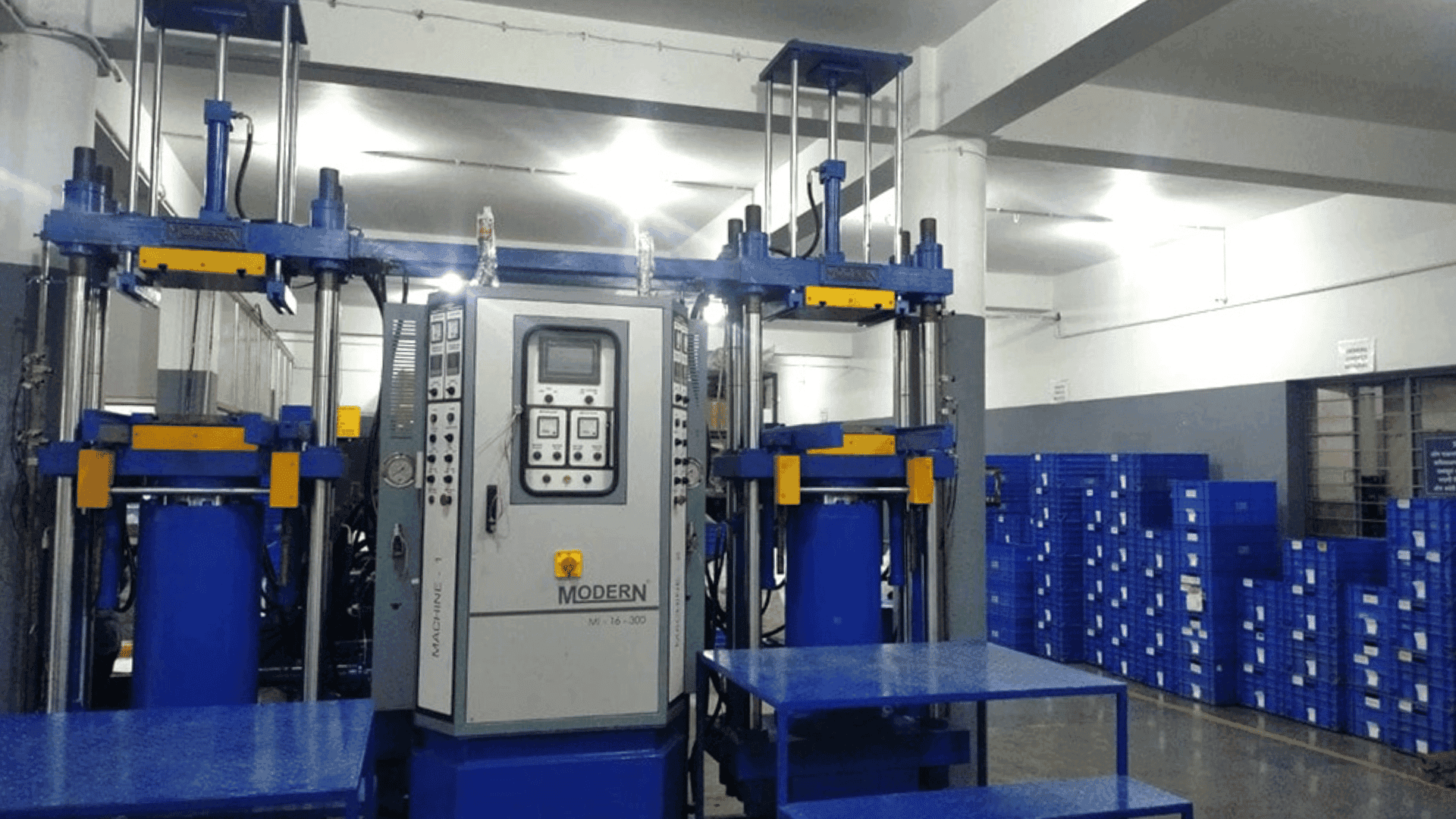
- Model / Series
- Application
- Key Requirement
MI-HP-12 to MI-HP-20 (37T–200T)
Moulding rubber cots onto metal cores — bonding rubber sleeve under heat and pressure
PLC cure for consistent hardness and bond strength. Small-platen press suits cot dimensions.

- Model / Series
- Application
- Key Requirement
Cylindrical cot grinder
Grinding cured cots to final diameter, TIR, and surface finish
TIR 0.02–0.04 mm. Specialist cot grinding machines from textile equipment suppliers.
Note: In certain specialized applications, extruders with cross-head attachments may also be used for rubber application on cores, depending on production method and product requirements.
Rubber Cots & Aprons Manufacturing Process
Compound Preparation: NR or NR/SBR compound prepared on Mixing Mill (M3–M5 AFB) to target Shore hardness. Hydraulic nip adjustment ensures consistent compound strip gauge — directly controlling rubber layer uniformity on the finished cot.
Core Preparation & Building: Metal mandrel cleaned and coated with bonding agent. Rubber strip wrapped around core in controlled build-up to pre-grind diameter.
Vulcanising (Hydraulic Press): Rubber-built cot placed in cylindrical mould. MI-HP press closes at programmed temperature, pressure, and cure time — vulcanizing the rubber and developing the metal-rubber bond.
Grinding: Cured cot ground on cylindrical grinding machine to final diameter, TIR 0.02–0.04 mm, and surface finish specification.
Quality Inspection & Buffing: Diameter, TIR, and Shore hardness checked. Accepted cots buffed for surface finishing. Re-grinding of worn cots (buffing service) uses the same grinding equipment.
Rubber Cots & Aprons Machinery — Coimbatore, Surat & Key Textile Clusters
India's rubber cots and aprons manufacturing industry is concentrated in the same cities and states as the spinning industry it serves:
Coimbatore · Tirupur · Erode
- State
- Primary Yarn
- Cots Demand
Tamil Nadu
Cotton · polyester-cotton
Highest cots consumption in India — dense ring spinning cluster
Surat
- State
- Primary Yarn
- Cots Demand
Gujarat
Synthetic — polyester, nylon
Large synthetic yarn segment. Different hardness spec from cotton cots.
Ahmedabad · Rajkot
- State
- Primary Yarn
- Cots Demand
Gujarat
Cotton · denim
Established cotton spinning base. Growing demand from mill modernisation.
Ludhiana · Amritsar
- State
- Primary Yarn
- Cots Demand
Punjab
Woollen · acrylic · cotton
Woollen ring frames use softer cots — different compound specification.
Mumbai · Bhiwandi
- State
- Primary Yarn
- Cots Demand
Maharashtra
Polyester-cotton blends
Blended yarn spinning. Close to Modern Industries base.
Modern Industries is headquartered in GIDC Umbergaon, Gujarat — serving Gujarat textile clusters (Surat, Ahmedabad, Rajkot) with short delivery times and fast after-sales service. For Tamil Nadu buyers in Coimbatore and Tirupur, we ship through Mundra or JNPT.
Why Cots & Aprons Manufacturers Choose Modern Industries
- Hydraulic nip adjustment on all AFB Mixing Mills — consistent compound strip gauge controls rubber layer thickness uniformity on the built cot, reducing grinding stock variation and finished cot rejection rate
- PLC-controlled MI-HP presses with digital temperature control — hardness variation of even plus or minus 2 Shore A points causes spin performance complaints. Consistent cure = consistent hardness batch after batch
- Press range from 37T (MI-HP-12) to 200T (MI-HP-20) — the right tonnage for cot mould dimensions without over-investing in a large press platform
- 50 years of rubber machinery manufacturing — after-sales support across India's textile manufacturing states
- Gujarat proximity to Surat and Ahmedabad clusters — shorter delivery lead time and faster commissioning for Gujarat-based cots manufacturers
Frequently Asked Questions — Rubber Cots & Aprons Machinery
What machines are needed to manufacture rubber cots for spinning frames?
Three machines are used: (1) a Rubber Mixing Mill (M3–M5 AFB) for compound preparation to the required Shore hardness specification, (2) a Hydraulic Press (MI-HP-12 to MI-HP-20, 37T–200T) for vulcanising the rubber onto the cot mandrel, and (3) a specialist Cot Grinding Machine for grinding to final diameter, TIR, and surface finish. Modern Industries supplies the Mixing Mill and Hydraulic Press.
What rubber compound is used for spinning frame cots?
Spinning frame rubber cots are typically manufactured from Natural Rubber (NR) or NR/SBR blends at 60–80 Shore A hardness. Cotton yarn uses 65–75 Shore A. Fine counts (high draft) may use softer cots at 60–65 Shore A. Synthetic fibre spinning (polyester, nylon) uses harder cots at 72–80 Shore A. Compound preparation on the Mixing Mill must achieve tight hardness tolerances.
What is the difference between rubber cots and rubber aprons?
A rubber cot is a cylindrical rubber sleeve on the top roller arm — it creates the nipping surface in the drafting zone. A rubber apron is a flat continuous rubber belt that wraps around a cradle in the drafting zone — carrying the fibre sliver through high-draft drafting. Both are consumable components in ring spinning frames and speed frames, produced from similar rubber compound formulations.
What Shore hardness should rubber cots be for cotton spinning?
Standard cotton ring spinning uses cots in the 65–75 Shore A range. Coarser counts tolerate harder cots at 72–75 Shore A. Finer counts (high draft) use softer cots at 65–68 Shore A for better fibre control. Hardness specification is confirmed by the spinning mill’s technical team. Modern Industries AFB Mixing Mills with hydraulic nip adjustment provide the compound consistency to hit hardness targets reliably batch after batch.
What is cot buffing and how does it relate to cot manufacturing machinery?
Cot buffing is the process of re-grinding worn cots — removing the hardened or worn surface layer to restore the original diameter and surface finish, extending cot service life by 2–4 additional cycles. Cots manufacturers offering buffing services use the same grinding machine as for new cot production. The Mixing Mill and Hydraulic Press from Modern Industries also support complete re-covering of stripped cores.