


Conveyor Belt Manufacturing Machinery India — Calender, Mixing Mill & Kneader
Rubber calender machines, mixing mills, and dispersion kneaders for industrial, mining, food-grade, and steel plant conveyor belt manufacturers — supplied from GIDC Umbergaon, Gujarat across India and 19+ export countries.
Core Industries
Countries
Conveyor Belt Manufacturing — A High-Demand Rubber Processing Segment
Conveyor belts are the circulatory system of heavy industry. Coal mines, steel plants, cement factories, grain silos, food processing units, and package logistics centres all depend on rubber conveyor belts running continuously under high load, across long distances, and in demanding environmental conditions.
Manufacturing a high-quality conveyor belt requires significant rubber processing capability — from internal compound mixing through to multi-layer fabric ply calendering and cover application. The machinery used must handle large-format, high-viscosity rubber compounds with precise temperature and thickness control across wide belt formats.
Modern Industries manufactures the complete upstream rubber processing line for conveyor belt manufacturers — dispersion kneaders for compound mixing, mixing mills for batching and sheeting, and wide-format calender machines for ply coating and belt cover application.
Machines Used in Conveyor Belt Manufacturing
Four machines form the production line for conveyor belt rubber compound preparation and belt construction:
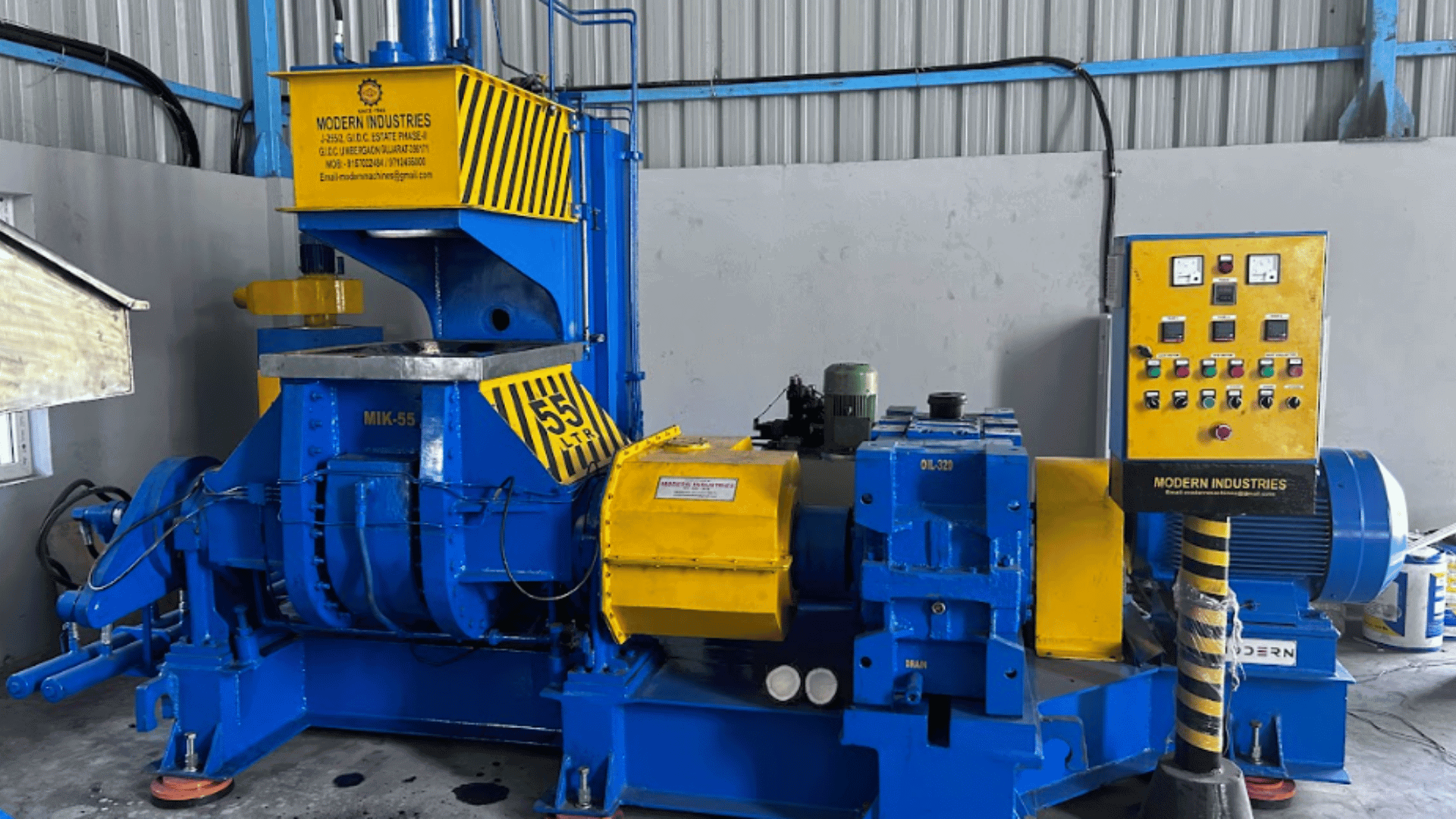
Dispersion Kneader
- Model / Series
- Application in Belt Plant
- Recommended Model
MIKH-7 to MIKH-9 (100L–150L)
High-carbon-black belt compound internal mixing — closed-chamber, high-shear
MIKH-9 (150L, 200 HP) for high-volume mining-grade belt compound
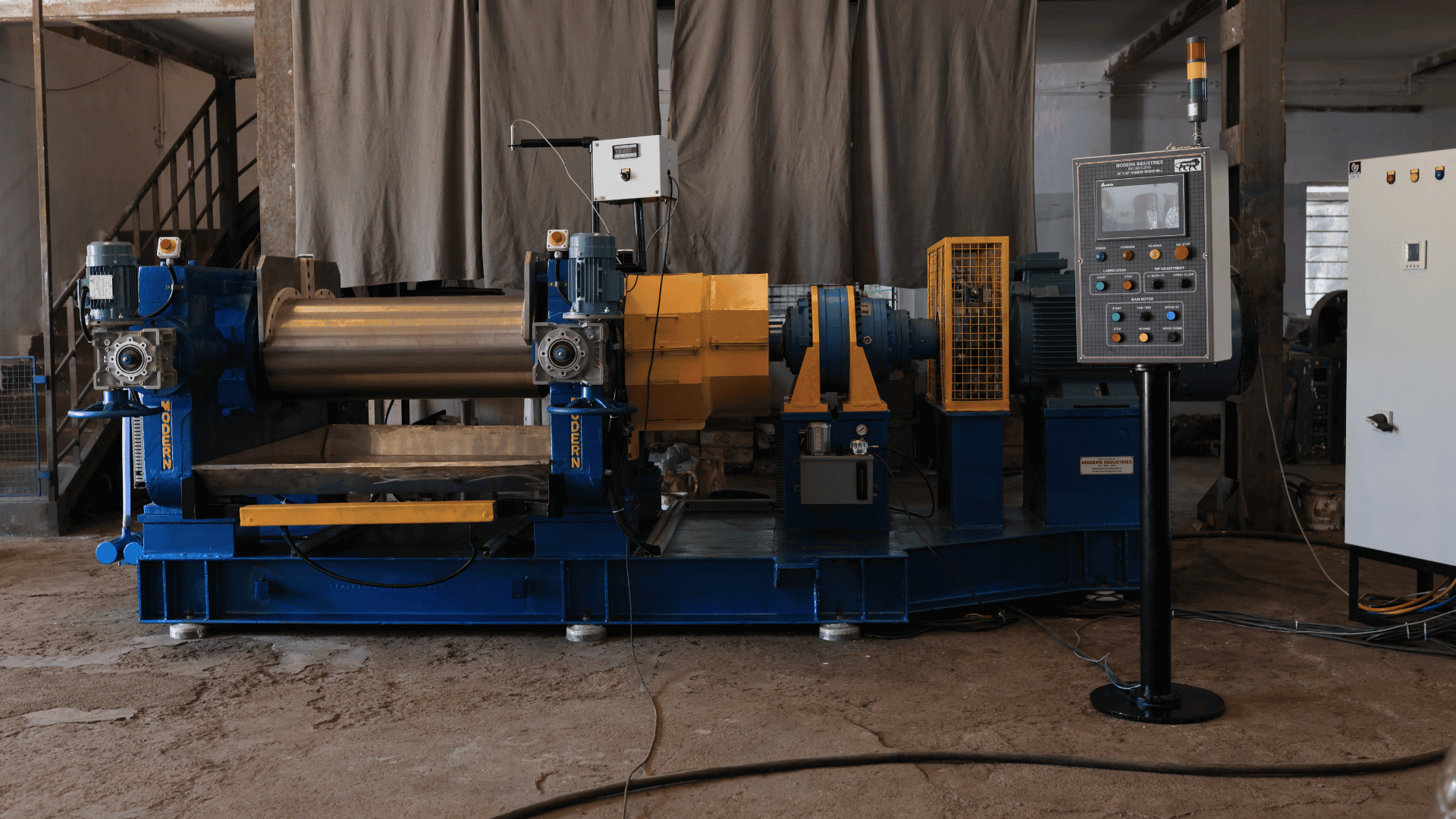
Rubber Mixing Mill
- Model / Series
- Application in Belt Plant
- Recommended Model
M6–M7 AFB (22"×60" to 26"×84")
Open-mill batching and sheeting of kneader compound output before calendering
M6-AFB (120 HP) — continuous output for high-production belt plant
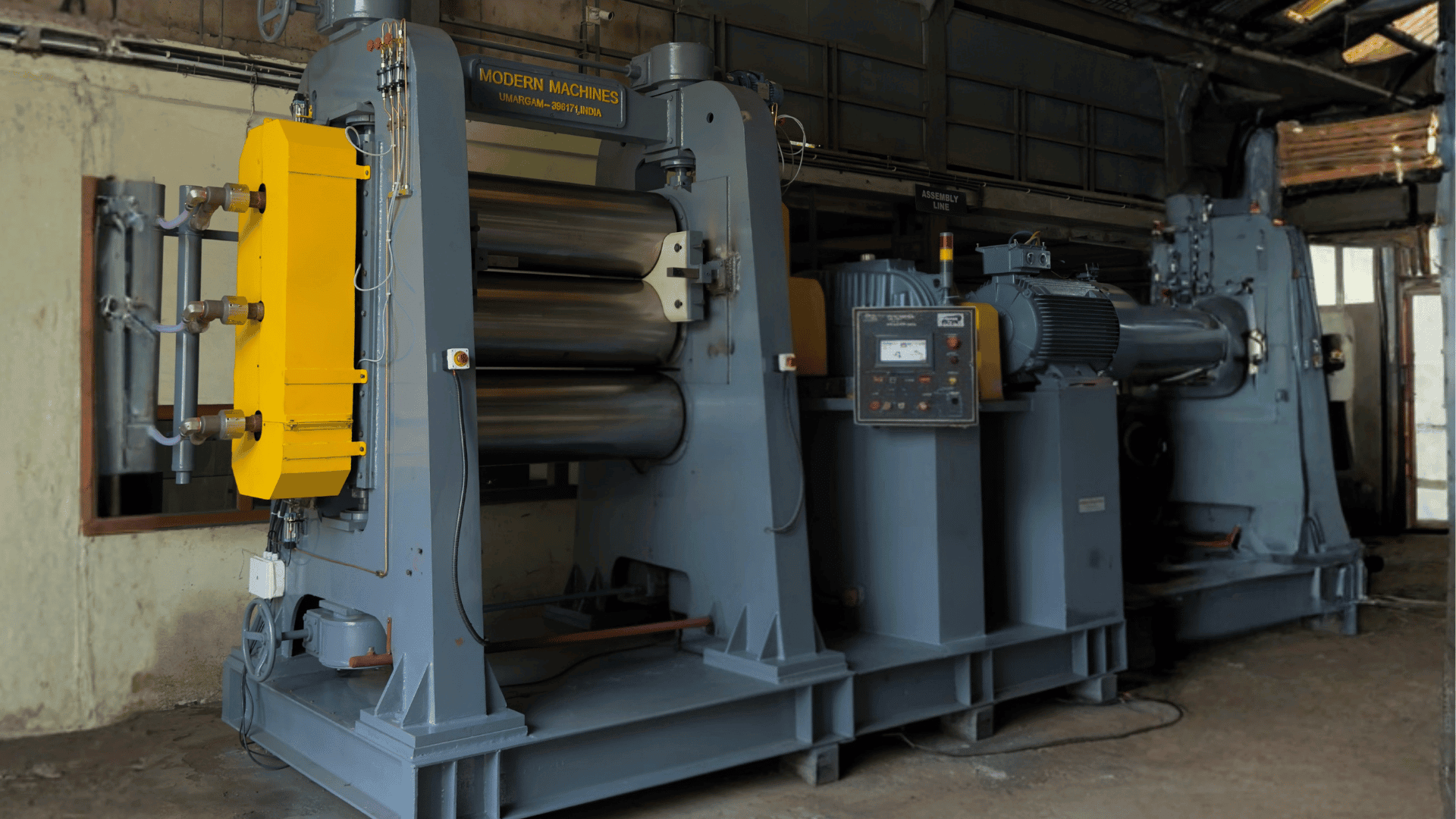
Calender Machine
- Model / Series
- Application in Belt Plant
- Recommended Model
MI-CL-18x54 / MI-CL-24x72
Belt ply fabric frictioning and top/bottom cover rubber application
MI-CL-24x72 (250 HP, 69" width) for full-width single-pass belt cover
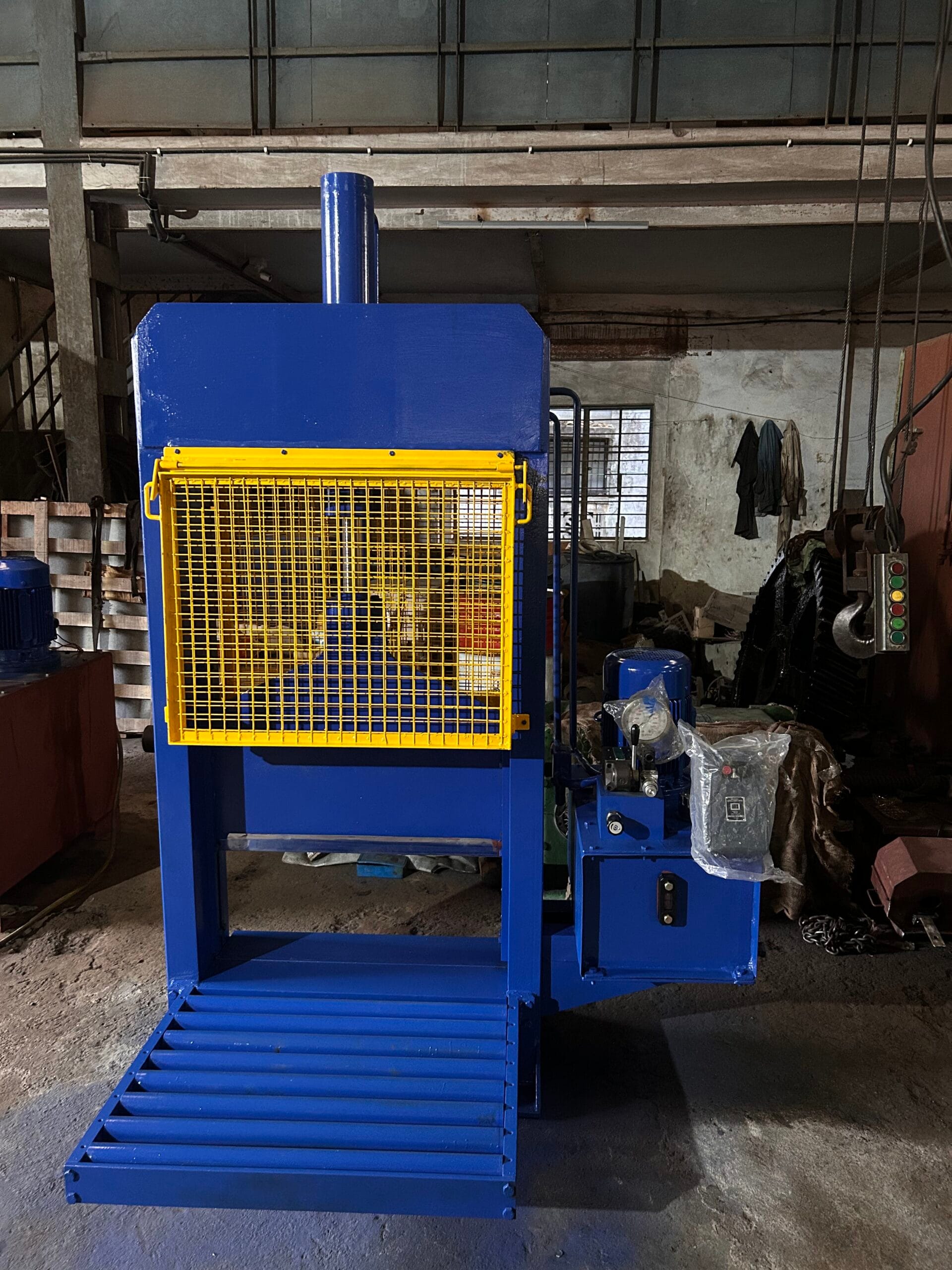
Rubber Bale Cutter
- Model / Series
- Application in Belt Plant
- Recommended Model
MI-BCM
Natural rubber bale preparation before compound mixing line
MI-BCM (20T single model)
Conveyor Belt Manufacturing Machinery — Ahmedabad & Gujarat
Gujarat is India's largest industrial hub for conveyor belt manufacturing, with a concentration of belt manufacturers in Ahmedabad, Surat, Rajkot, and the industrial corridors connecting them. The state's proximity to both the mining regions of Rajasthan and the port infrastructure of Mundra and Hazira makes it a natural base for belt manufacturers supplying both domestic mining and export markets.
Modern Industries is headquartered in GIDC Umbergaon, Gujarat — a short distance from Ahmedabad, Surat, and India's major container ports. Belt manufacturers in Ahmedabad and across Gujarat benefit from short delivery distances, easy commissioning access, and fast after-sales response from our service team.
If you are setting up or expanding a conveyor belt manufacturing plant in Ahmedabad, Surat, Rajkot, or anywhere in Gujarat — contact our engineering team for a complete machinery list and quotation matched to your belt specification and production capacity target.
Conveyor Belt Manufacturing Process — Machines at Every Stage
Stage 1 — Belt Rubber Compound Mixing
Conveyor belt rubber compound — loaded with carbon black, fillers, and reinforcing agents — is mixed in the Dispersion Kneader (MIKH-7 to MIKH-9, 100L–150L). Belt compound typically contains 40–60 parts of carbon black per 100 parts rubber — a high-filler formulation that requires the closed-chamber intensive shear of an internal mixer for complete, uniform dispersion. Open-mill mixing alone cannot achieve the required dispersion quality for mining-grade and industrial belt rubber.
Stage 2 — Open Mill Batching & Sheeting
Kneader output is transferred to the Mixing Mill (M6–M7 AFB) for open-mill batching — final additive incorporation, compound viscosity adjustment, and sheeting to the required gauge for calender feeding. The hydraulic stock blender on AFB mills assists the operator during this stage, speeding the batching cycle and reducing manual handling time.
Stage 3 — Ply Fabric Frictioning
The Calender Machine (MI-CL-18x54 or MI-CL-24x72) applies rubber compound to both faces of the nylon or polyester belt ply fabric simultaneously in a single pass using a 4-roll Z-Type configuration. The rubber is forced into the fabric interstices under nip pressure — producing fully impregnated, rubber-coated ply that is the structural core of the finished belt.
The MI-CL-24x72 (69" maximum sheet width) covers standard industrial belt widths — up to 1,800 mm — in a single pass without jointing. Crown compensation and roll-crossing technology ensure uniform rubber application across the full fabric width, preventing thin spots that would cause belt delamination in service.
Stage 4 — Belt Cover Application
After the ply assembly is built up from multiple frictioned plies, the top cover (wear-resistant) and bottom cover (pulley-side) rubber are applied by the calender machine. Cover thickness depends on belt grade — typically 3–6 mm top cover for general industrial belts and 8–20 mm for heavy-duty mining belts.
Stage 5 — Vulcanising
The assembled belt is vulcanised in a continuous belt press (for long-length belts) or a flat vulcanising press (for short-length and special-purpose belts). Modern Industries supplies the upstream compound preparation machinery and calender. Contact our team if you also require a flat vulcanising press configuration.
Belt Types — Machines & Compound Requirements
Industrial conveyor (general)
- Rubber Compound
- Primary Machine
- Key Requirement
SBR or NR/SBR blend
MI-CL-18x54 Calender
Consistent ply thickness, adhesion quality
Mining-grade belt (heavy duty)
- Rubber Compound
- Primary Machine
- Key Requirement
NR high-filler
MI-CL-24x72 + MIKH-9
Abrasion resistance, heat resistance, deep frictioning
Food-grade conveyor belt
- Rubber Compound
- Primary Machine
- Key Requirement
FDA-approved EPDM
MI-CL-14x42 or MI-CL-18x54
Food-contact compliant compound, clean calendering
Heat-resistant belt
- Rubber Compound
- Primary Machine
- Key Requirement
EPDM or SBR/NR special
MIKH-7 + MI-CL-18x54
Heat resistance up to 150°C+, no compound degradation
Oil-resistant belt
- Rubber Compound
- Primary Machine
- Key Requirement
NBR (nitrile)
MIKH-6 + MI-CL-14x42
NBR compound — resistance to oils, fats, and hydrocarbons
Steel-cord belt
- Rubber Compound
- Primary Machine
- Key Requirement
High-tenacity NR
MI-CL-24x72 (4-roll)
Uniform rubber embedding of steel cord wires
Why Conveyor Belt Manufacturers Choose Modern Industries
- MI-CL-24x72 calender (250 HP, 69" width) covers standard industrial belt widths up to 1,800 mm in a single pass — no jointing, no seam lines that would create weak points in the finished belt
- 4-roll Z-Type calender configuration coats both ply fabric faces simultaneously — producing complete rubber penetration from both surfaces in one pass, the requirement for high-quality industrial belt ply
- MIKH-9 kneader (150L, 200 HP) handles the high-viscosity, high-carbon-black belt compound batches required for mining-grade and heavy industrial belt production without cycle time compromise
- Complete line from one supplier — Bale Cutter + Kneader + Mixing Mill + Calender — ensures machine compatibility at every transfer point and simplifies after-sales service across the full production line
- Proximity to Ahmedabad and Gujarat belt manufacturing clusters — short delivery, fast commissioning, and rapid after-sales service from our GIDC Umbergaon base
Frequently Asked Questions — Conveyor Belt Manufacturing Machinery
What machines are needed for a conveyor belt manufacturing plant?
A complete conveyor belt manufacturing plant requires: a Rubber Bale Cutter (MI-BCM) for front-end preparation, a Dispersion Kneader (MIKH-7 to MIKH-9) for compound mixing, a Rubber Mixing Mill (M6–M7 AFB) for batching and sheeting, and a Calender Machine (MI-CL-18×54 or MI-CL-24×72) for ply frictioning and cover application. Modern Industries supplies all four machines and can provide a complete line specification matched to your belt grade and daily output target.
What calender machine width is needed for conveyor belt manufacturing?
Calender machine selection depends on your maximum belt width. The MI-CL-18×54 (75 HP, 51″ working width) suits belts up to 1,200 mm wide. The MI-CL-24×72 (250 HP, 69″ working width) covers belts up to 1,800 mm. For wider mining belts, custom roll sizes are available on request. The 4-roll Z-Type configuration is recommended for simultaneous double-sided ply frictioning.
Why is a dispersion kneader necessary for belt compound — can I use only a mixing mill?
Belt rubber compound typically contains 40–60 parts of carbon black per 100 parts rubber. At this filler loading, an open mixing mill cannot achieve complete carbon black dispersion — the compound will have filler-rich and filler-lean zones that create inconsistent physical properties across the belt. A dispersion kneader (closed chamber, high-shear) is essential for uniform dispersion in high-filler belt compounds. The mixing mill is then used for the open-mill batching stage that follows the kneader.
What is the difference between 3-roll and 4-roll calenders for belt ply frictioning?
A 3-roll calender applies rubber to one side of the ply fabric per pass — requiring two passes for double-sided frictioning. A 4-roll Z-Type calender applies rubber to both faces simultaneously in a single pass, producing higher-quality rubber penetration and bonding from both sides. For industrial and mining-grade belt ply, 4-roll Z-Type frictioning is strongly preferred for ply adhesion strength and resistance to delamination in service.
Can Modern Industries supply machinery for a new conveyor belt factory setup in Gujarat?
Yes. Modern Industries regularly supplies complete machinery packages for new belt plant setups. We provide the full upstream line — bale cutter, kneader, mixing mill, and calender — with installation support and commissioning at your plant. For buyers in Ahmedabad, Surat, and Gujarat, our proximity means shorter lead times and faster on-site commissioning. Contact our engineering team with your required belt grades and daily production target for a complete machinery specification and quotation.