


Rubber Machinery for Footwear Industry India — Sole Making Machines
Mixing mills, calender machines, and hydraulic presses for slipper, sandal, safety boot, and chappal manufacturers — supplied to footwear clusters in Tamil Nadu, Gujarat, West Bengal, and Agra.
Core Industries
Countries
India's Footwear Industry — A Growing Manufacturing Base
India is the world's second-largest footwear producer, with an annual output of over 2 billion pairs. The industry is concentrated in a handful of high-density manufacturing clusters — Tamil Nadu (Chennai, Ambur, Ranipet), West Bengal (Kolkata), Uttar Pradesh (Agra, Kanpur), and Gujarat (Rajkot, Surat). Each cluster has its own product specialisation — from quality leather footwear in Agra to mass-market rubber slippers and sandals in Tamil Nadu and Gujarat.
Rubber and EVA sole production is at the core of every footwear manufacturing cluster. Whether making slippers, sandals, safety boots, or chappal — the compound preparation, sole sheeting, and moulding process runs on rubber processing machinery. Modern Industries supplies this machinery to footwear manufacturers across all major clusters.
Machines Used in Footwear Rubber Manufacturing
Three core machines serve the rubber sole production line in footwear manufacturing:
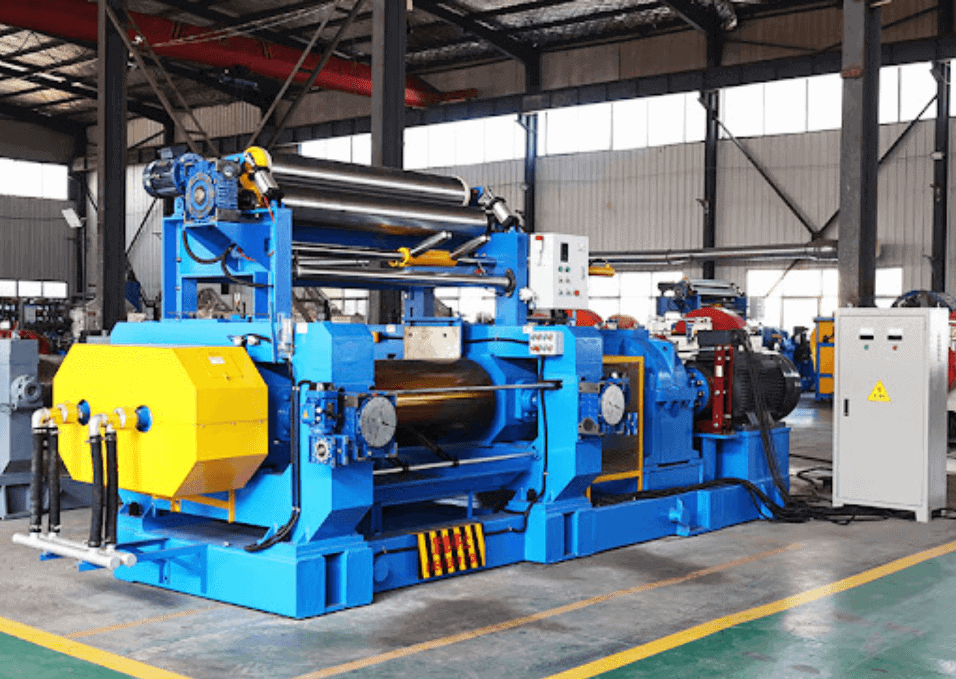
Rubber Mixing Mill
- Model Series
- Application in Footwear Plant
- Recommended Model
AFB Series (M1–M8)
Sole rubber compound mixing — SBR, EVA, NR blends with colour pigments
M3–M5 AFB (14"×36" to 18"×48")
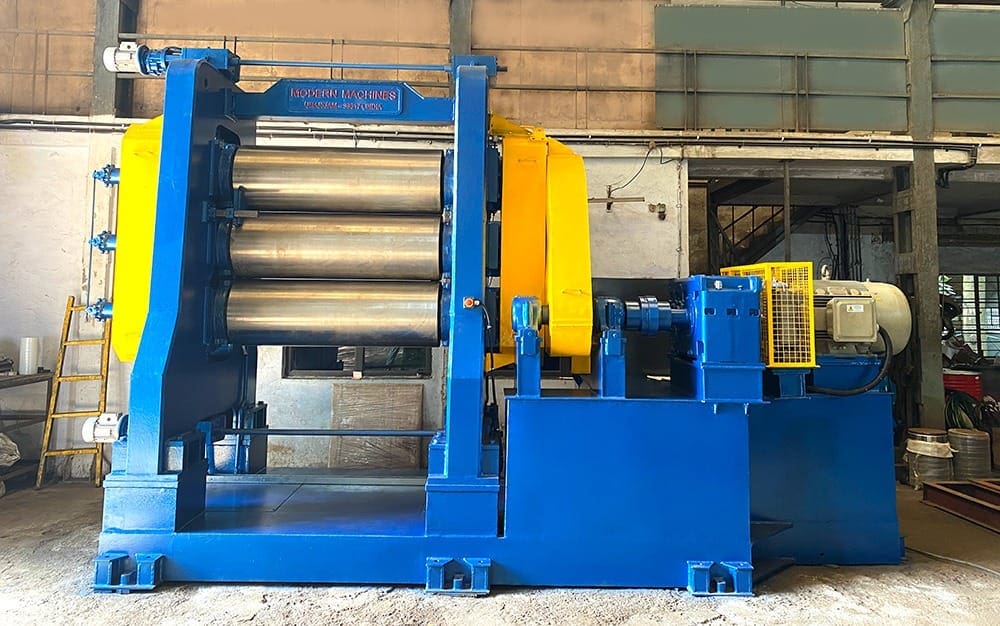
Calender Machine
- Model Series
- Application in Footwear Plant
- Recommended Model
MI-CL Series
Rubber sole sheet production at controlled, uniform thickness for sole blank cutting
MI-CL-10x30 / MI-CL-14x42
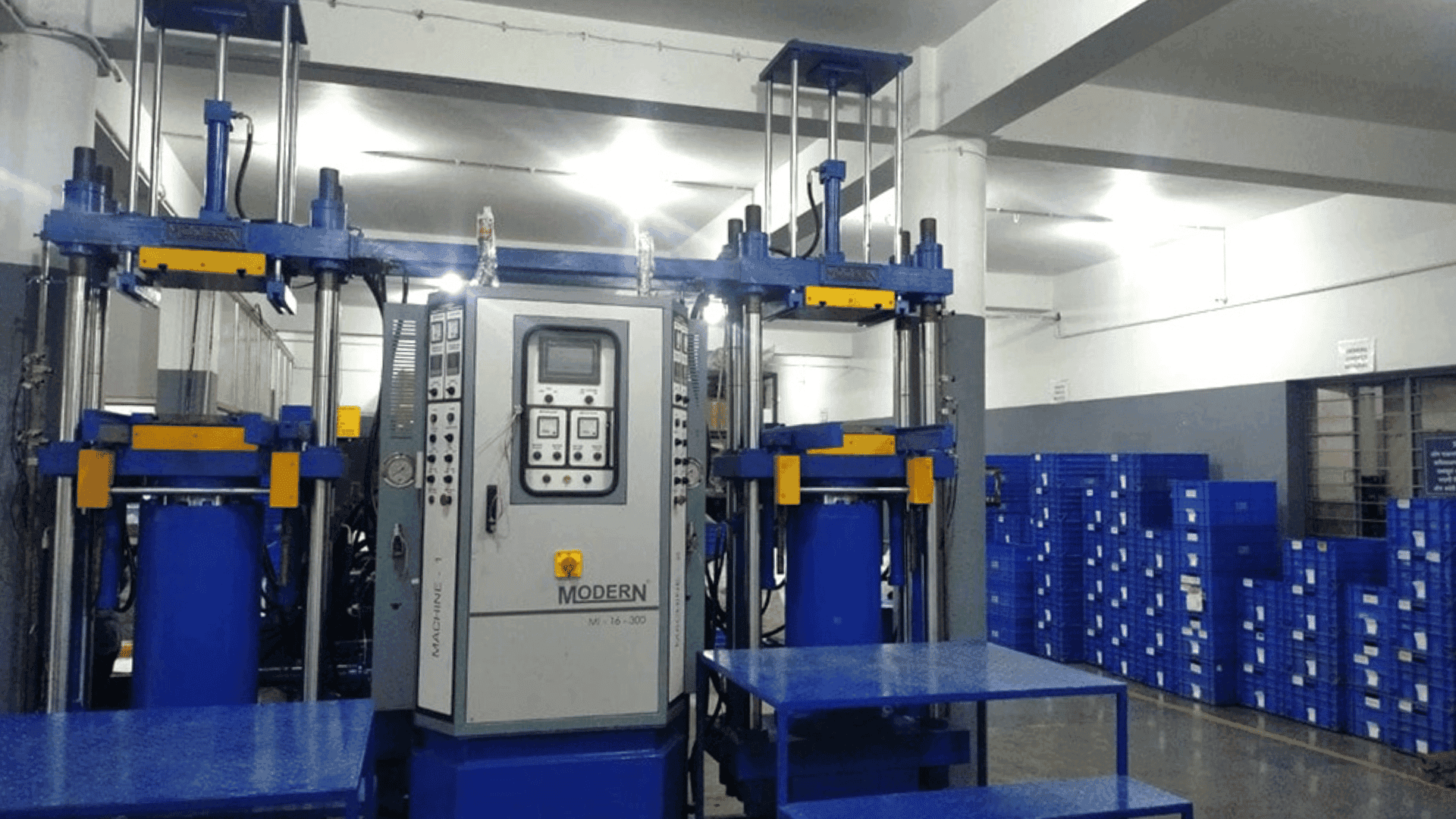
Hydraulic Press
- Model Series
- Application in Footwear Plant
- Recommended Model
MI-HP / MI-THP
Sole moulding — slipper soles, sandal bases, safety boot soles, chappal soles
MI-HP-16 to MI-HP-20 (100T–200T)
The double-station MI-THP Series press is widely used in high-volume footwear factories — one station loads and unloads while the other is in the cure cycle, significantly increasing throughput.
Rubber Sheet Making Machine for Footwear — The Calender Process
In footwear rubber manufacturing, the calender machine is the rubber sheet making machine. It takes compounded rubber from the mixing mill and produces flat rubber sheets at a precisely controlled thickness — typically 3–8 mm — which are then cut into sole blanks before moulding.
The MI-CL-10x30 (20 HP, 27" width) and MI-CL-14x42 (40 HP, 39" width) are the standard calender sizes for footwear rubber production. Precise nip adjustment on both models allows the operator to produce sole blanks at consistent gauge — essential for flash-free moulding and uniform sole weight across a production run.
- Sheet thickness range: 1 mm to 20 mm (set by nip gap)
- Friction ratio: 1:1.25 standard — suitable for SBR, EVA, and NR sole compounds
- Motorised nip adjustment — consistent sheet thickness across full production shifts
- Linked to mixing mill output — compound sheets direct from mill to calender feed
Footwear Rubber Manufacturing Process — Step by Step
Step 1 — Sole Compound Mixing
SBR, EVA, or natural rubber is compounded with fillers, colour pigments, and curatives on the Mixing Mill (M3–M5 AFB). The hydraulic stock blender standard on all AFB mills assists the operator in dispersing colour pigments and chemical powders evenly — significantly reducing compound mixing time compared to manual folding.
Step 2 — Rubber Sheet Production
The compounded rubber is fed into the Calender Machine (MI-CL-10x30 or MI-CL-14x42) and sheeted to the required sole blank thickness. Sheet width and thickness are set at the nip. Digital nip gap indicators maintain consistent gauge throughout the production run.
Step 3 — Sole Blank Cutting
The calendered rubber sheet is cut into sole blanks — either manually or using a die-cut press — matching the mould cavity dimensions. Blank weight is calibrated to the mould cavity volume for flash-free moulding.
Step 4 — Sole Moulding & Curing
Sole blanks are placed in the mould cavity in the Hydraulic Press (MI-HP-16 to MI-HP-20). The PLC-controlled press closes at programmed speed and pressure, curing the sole at temperature for the required cure time. The double-station MI-THP Series allows one mould to be loading while the other is curing — keeping the press in continuous production.
Step 5 — Quality Control
Cured soles are checked for dimensional accuracy, flash removal, surface finish, and Shore hardness. Compound QC batches are run on a laboratory mixing mill at the start of each production run to confirm compound properties before full-scale production begins.
Footwear Manufacturing Clusters — Where Modern Industries Machines Are Installed

Tamil Nadu (Ambur · Ranipet · Vellore)
- Primary Product
- Recommended Machines
- Key Segment
Rubber slippers · sandals · chappal
Mixing Mill M3–M5 · Calender MI-CL-10x30 · Press MI-HP-16/18
Mass market domestic
West Bengal (Kolkata)
- Primary Product
- Recommended Machines
- Key Segment
Rubber sandals · school shoes · rubber soles
Mixing Mill M3–M5 · Press MI-HP-16 to MI-HP-20
Domestic + export
Uttar Pradesh (Agra · Kanpur)
- Primary Product
- Recommended Machines
- Key Segment
Leather + rubber combination · safety footwear
Press MI-HP-18 to MI-HP-24 · Mixing Mill M4–M5
Industrial footwear
Gujarat (Rajkot · Surat)
- Primary Product
- Recommended Machines
- Key Segment
EVA soles · rubber sandals · safety footwear
Mixing Mill M3–M5 · Calender MI-CL-14x42 · Press MI-HP-16
Domestic + Gulf export
Footwear Rubber Segment
Modern Industries has supplied rubber processing machinery for rubber goods and footwear component production operations.
Footwear RubberFlair
Why Footwear Manufacturers Choose Modern Industries
- MI-CL calender machines (MI-CL-10x30 and MI-CL-14x42) produce consistent sole blank sheet thickness across the full roll width — essential for uniform sole weight and flash-free moulding in high-speed footwear production
- Hydraulic stock blender standard on all AFB mixing mills — speeds colour pigment dispersion in sole compound batches, reducing mixing cycle time on multi-colour production runs
- Double-station MI-THP press — one station loads while the other cures, keeping the press in continuous production and increasing throughput significantly over single-station presses
- Widely installed across Tamil Nadu, Gujarat, and West Bengal footwear clusters — local reference sites available for factory visits before purchase
- Complete 3-machine line from one supplier — Mixing Mill + Calender + Press — ensuring compatibility and simplifying after-sales service for all three machines
Frequently Asked Questions — Footwear Rubber Machinery
What machines are needed to make rubber soles for slippers and sandals?
For slipper and sandal sole manufacturing, you need three machines: (1) a Rubber Mixing Mill (M3–M5 AFB) to compound the rubber, (2) a Calender Machine (MI-CL-10×30 or MI-CL-14×42) to sheet the compound at sole blank thickness, and (3) a Hydraulic Press (MI-HP-16 to MI-HP-20, 100T–200T) to mould and cure the sole. Modern Industries supplies all three machines as a coordinated production line.
What is a rubber sheet making machine for footwear?
In footwear manufacturing, the rubber sheet making machine is a calender machine that passes compounded rubber between precision-controlled rolls to produce flat rubber sheets at a controlled, uniform thickness. These sheets are cut into sole blanks before compression moulding in a hydraulic press. Typical sheet thickness for footwear is 3–8 mm, set by the calender’s nip gap.
What tonnage hydraulic press is needed for slipper sole moulding?
Slipper and sandal sole moulding typically requires 100T–150T. The MI-HP-16 (100T, 410×410 mm platen) handles single-cavity slipper sole moulds. The MI-HP-18 (150T, 460×460 mm) suits multi-cavity slipper moulds or larger sandal moulds. For safety boot and industrial footwear soles, MI-HP-20 (200T) or MI-HP-24 (250T, 600×600 mm) is used. Confirmed recommendation based on your mould dimensions.
What is the difference between a single-station and double-station press for sole moulding?
A single-station press (MI-HP Series) has one heating platen — the mould is loaded, cured, and unloaded from a single position. A double-station press (MI-THP Series) has two heating stations — while one station is in the cure cycle, the other can be loading or unloading a mould. This eliminates press idle time and increases output significantly on high-volume footwear production lines.
Do Modern Industries machines process EVA rubber for footwear soles?
Yes. Modern Industries Mixing Mills (AFB Series) and Hydraulic Presses (MI-HP Series) process EVA (Ethylene Vinyl Acetate) compounds for slipper and sandal sole production. EVA requires specific temperature settings and shorter cure times than conventional rubber — both managed through the PLC-controlled press. For EVA sheet production, the calender machine is used at lower nip pressure than for SBR compounds.