


Rubber Hose Manufacturing Machine India — Hot & Cold Feed Extruder
Hot feed and cold feed rubber extruders for hydraulic hose, garden hose, industrial tubing, automotive hose, and medical tubing manufacturers — with upstream mixing mills for compound preparation. Supplied from GIDC Umbergaon, Gujarat.
Core Industries
Countries
Rubber Hose & Tubing — India's Most Widely Used Extruded Rubber Product
Rubber hoses and tubes are found everywhere — in every vehicle engine bay, every hydraulic system, every garden, every industrial plant, and every medical facility. Rubber hose manufacturing is one of the largest application segments in the Indian rubber industry, with manufacturers concentrated in Gujarat, Maharashtra, Tamil Nadu, and West Bengal.
Whether producing a simple garden hose, a high-pressure hydraulic hose, an automotive radiator hose, or a medical-grade silicone tube — the core manufacturing process is extrusion: forcing a rubber compound through a shaped die to produce a continuous tube or hose profile.
Modern Industries supplies the two primary extrusion machines for rubber hose and tubing production — the Hot Feed Extruder and the Cold Feed Extruder — along with upstream Rubber Mixing Mills for compound preparation.
Machines Used for Rubber Hose & Tubing Manufacturing
Three machines form the production line for rubber hose and tubing manufacturing:
Extruder — warm compound feed
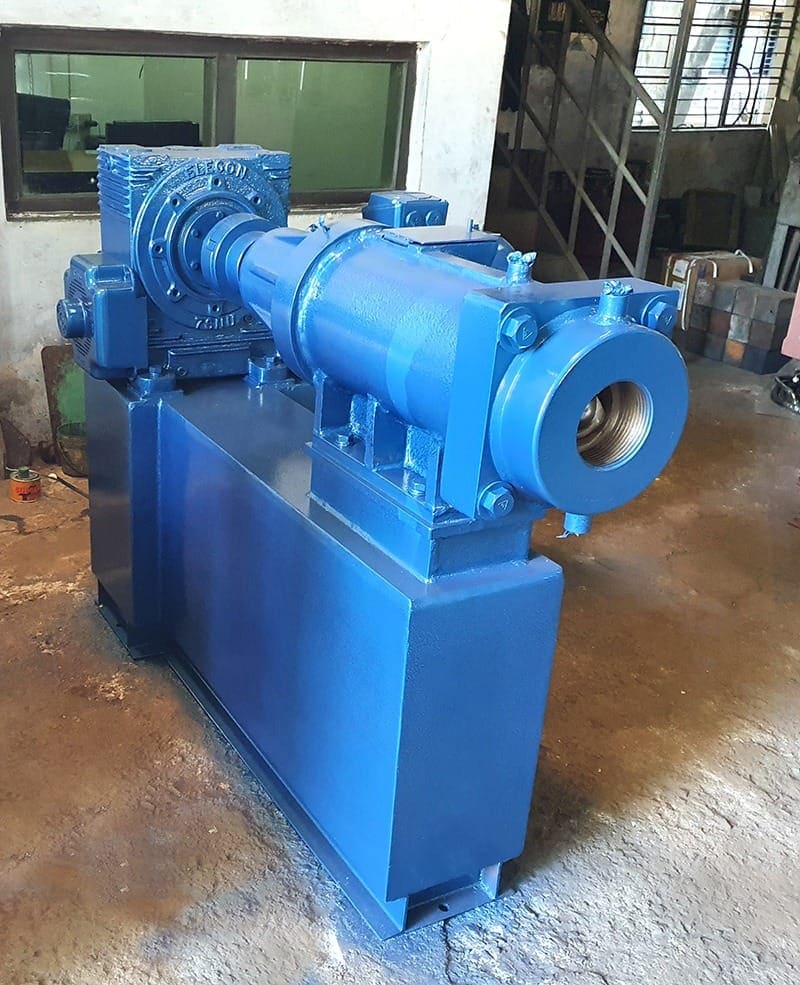
Hot Feed Extruder
Application: Continuous extrusion of pre-heated rubber compound through a tube or hose die
Best For: Large-diameter hoses, thick-wall tubing, high-output production lines
Extruder — room-temp compound feed

Cold Feed Extruder
Application: Continuous extrusion of pre-mixed, unheated compound for precise dimensional control
Best For: Automotive hose, hydraulic hose, medical tubing, small-diameter precision tube
AFB Series (M3–M6 AFB)
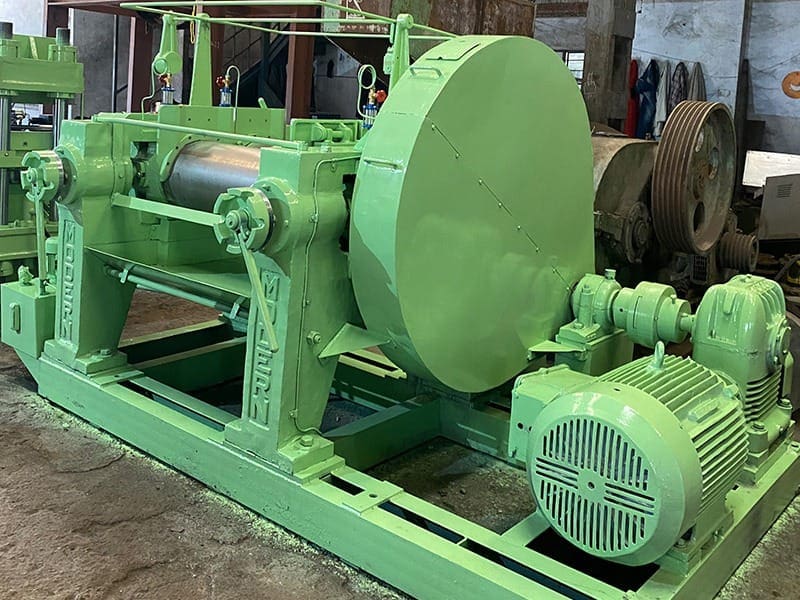
Rubber Mixing Mill
Application: Compound preparation — SBR, EPDM, NBR, NR blended with fillers and cure agents
Best For: Upstream compound prep for both hot feed and cold feed extrusion lines
Hot Feed Extruder vs Cold Feed Extruder — Which Do You Need?
The choice between a Hot Feed Extruder and a Cold Feed Extruder is one of the most common questions from hose manufacturers.
The answer depends on your hose type, production volume, and dimensional tolerance requirement.
| Comparison Point | Hot Feed Extruder | Cold Feed Extruder |
|---|---|---|
| Compound feed | Pre-warmed compound from a warm mill (40–70°C) | Room-temperature compound direct from mixing mill |
| Dimensional accuracy | Good — suitable for large-section and thick-wall hose | Superior — preferred for precision-bore tubing and automotive hose |
| Output rate | Higher output for large-diameter hose production | Moderate — better suited for controlled-dimension tubing |
| Best applications | Garden hose, fire hose, large industrial hose, general rubber tubing | Automotive radiator hose, hydraulic hose, medical tubing, small-bore precision tubes |
| Compound temperature | Compound pre-heated — shorter extruder residence time | Compound not pre-heated — shear heat developed in extruder barrel |
| Setup complexity | Simpler — requires warm mill upstream | More controlled — self-contained temperature management |
Rubber Hose Extrusion Process — Step by Step
Step 1 — Compound Preparation
The hose rubber compound — EPDM for weather and heat resistance, NBR for oil and fuel hose, NR/SBR for general-purpose hose — is prepared on the Rubber Mixing Mill (M3–M6 AFB). The compound is mixed with reinforcing fillers, plasticisers, and the cure system, then sheeted to a slab or strip suitable for extruder feeding.
Step 2 — Extrusion
For a Hot Feed Extruder: compound slabs are pre-warmed on a warm mill and fed as a warm strip into the extruder hopper. For a Cold Feed Extruder: pre-mixed compound is fed at room temperature. In both cases, the rotating screw forces the compound forward through the barrel and out through the shaped die — producing a seamless, continuous tube or hose profile at the die exit.
Die design determines the internal bore diameter, wall thickness, and outer diameter of the hose. Profile dies are used for oval or shaped cross-sections on automotive hose assemblies.
Step 3 — Mandrel Loading (Reinforced Hose)
For reinforced hose — hydraulic hose, high-pressure industrial hose — the extruded inner tube is loaded onto a rigid mandrel (flexible steel or nylon rod matching the internal bore diameter). The mandrel maintains the bore geometry during the braiding, wrapping, and vulcanising stages.
Step 4 — Reinforcement (Hydraulic & High-Pressure Hose)
Hydraulic and high-pressure hoses require textile or wire reinforcement around the inner tube. This is applied by a braiding machine or spiral winding machine — processes not supplied by Modern Industries but performed between the extrusion and cover application stages.
Step 5 — Cover Application & Vulcanising
The outer rubber cover is applied over the reinforcement layer — either by extrusion (a second extruder pass) or by hand wrapping. The assembled hose is then vulcanised in a steam autoclave or a continuous vulcanising unit, followed by mandrel stripping, cutting to length, and end fitting assembly.
Hose & Tubing Types — Machines & Compound Requirements
Garden hose (domestic)
Rubber Material: SBR or NR/SBR blend
Extruder Type: Hot Feed
Key Requirement: High output, simple bore, cost-effective production
Hydraulic hose (inner tube)
Rubber Material: NBR (nitrile)
Extruder Type: Cold Feed
Key Requirement: Precise bore diameter, oil resistance, mandrel production
Automotive radiator hose
Rubber Material: EPDM
Extruder Type: Cold Feed
Key Requirement: Heat and coolant resistance, dimensional accuracy for OEM fitment
Industrial pressure hose
Rubber Material: SBR or EPDM
Extruder Type: Hot Feed
Key Requirement: Large OD, high wall thickness, continuous high-output line
Fire hose
Rubber Material: NR or SBR
Extruder Type: Hot Feed
Key Requirement: Abrasion resistance, large bore, textile-reinforced outer
Medical / pharma tubing
Rubber Material: Silicone
Extruder Type: Silicone Extruder
Key Requirement: Biocompatibility, smooth bore, clean-room process
Fuel & oil transfer hose
Rubber Material: NBR
Extruder Type: Cold Feed
Key Requirement: Oil and fuel swell resistance, consistent wall thickness
Air brake hose (commercial vehicle)
Rubber Material: EPDM / NBR
Extruder Type: Cold Feed
Key Requirement: Temperature range, pressure rating, OEM spec compliance
Why Rubber Hose Manufacturers Choose Modern Industries
- Hot Feed and Cold Feed Extruders available from a single manufacturer — one supplier for both extrusion routes, with full interoperability with Modern Industries mixing mills upstream
- AFB Mixing Mills with hydraulic stock blender standard — consistent compound strip output at the required temperature for hot feed lines, minimising extruder feed variation
- Engineering guidance on extruder selection — Hot Feed vs Cold Feed, screw diameter, screw L/D ratio, and die specification are confirmed by our team against your hose type and output requirement
- 50 years of rubber machinery experience across all hose types — from simple garden hose to precision medical tubing and hydraulic hose — backed by after-sales service across India and 19+ export countries
Frequently Asked Questions — Rubber Hose Manufacturing Machinery
What is the difference between a hot feed and cold feed rubber extruder?
A hot feed extruder receives pre-warmed rubber compound (40–70°C) from a warm mill upstream and feeds it as a warm strip. A cold feed extruder takes room-temperature, pre-mixed compound directly — the extruder screw develops the required shear heat in the barrel. Cold feed extruders offer superior dimensional control for precision hose. Hot feed extruders suit high-output lines for large-section garden, industrial, or fire hose.
Which rubber extruder is best for hydraulic hose manufacturing?
Hydraulic hose inner tubes require precise bore diameter and consistent wall thickness — both requirements point to a Cold Feed Extruder. The controlled temperature management and superior dimensional accuracy of cold feed extrusion ensures the bore is within the tight tolerance required for hydraulic hose OEM specifications. NBR (nitrile) compound is standard for hydraulic hose inner tubes due to its oil and fuel resistance.
What compound is used for garden hose production?
Standard garden hose is produced from SBR (styrene-butadiene rubber) or an NR/SBR blend — both are cost-effective, weather-resistant compounds suitable for domestic water temperature and pressure ranges. The compound is prepared on a Mixing Mill (M3–M4 AFB) and fed warm to a Hot Feed Extruder for high-volume output. The inner bore is typically smooth-walled; some garden hose designs use a reinforcing braid between inner and outer tubes.
Can Modern Industries supply the complete rubber hose production line?
Modern Industries supplies the compound preparation machinery (Rubber Mixing Mill, AFB Series) and the extrusion machines (Hot Feed Extruder, Cold Feed Extruder). For a complete hose production line, you will also need a braiding machine (for reinforced hose), a vulcanising system (autoclave or continuous vulcanising unit), and mandrel equipment — these are sourced from specialised hose machinery suppliers. Our team can advise on line layout and machine interface requirements.
What screw diameter extruder is needed for rubber hose production?
Screw diameter selection depends on hose outer diameter and required output rate. Smaller diameter hose (under 25 mm OD) typically uses 45–60 mm screw extruders. Medium hose (25–75 mm OD) uses 75–90 mm screws. Large-diameter industrial and fire hose uses 115–150 mm screw extruders. Our engineering team will confirm the right screw diameter and L/D ratio for your specific hose specification and production rate requirement.