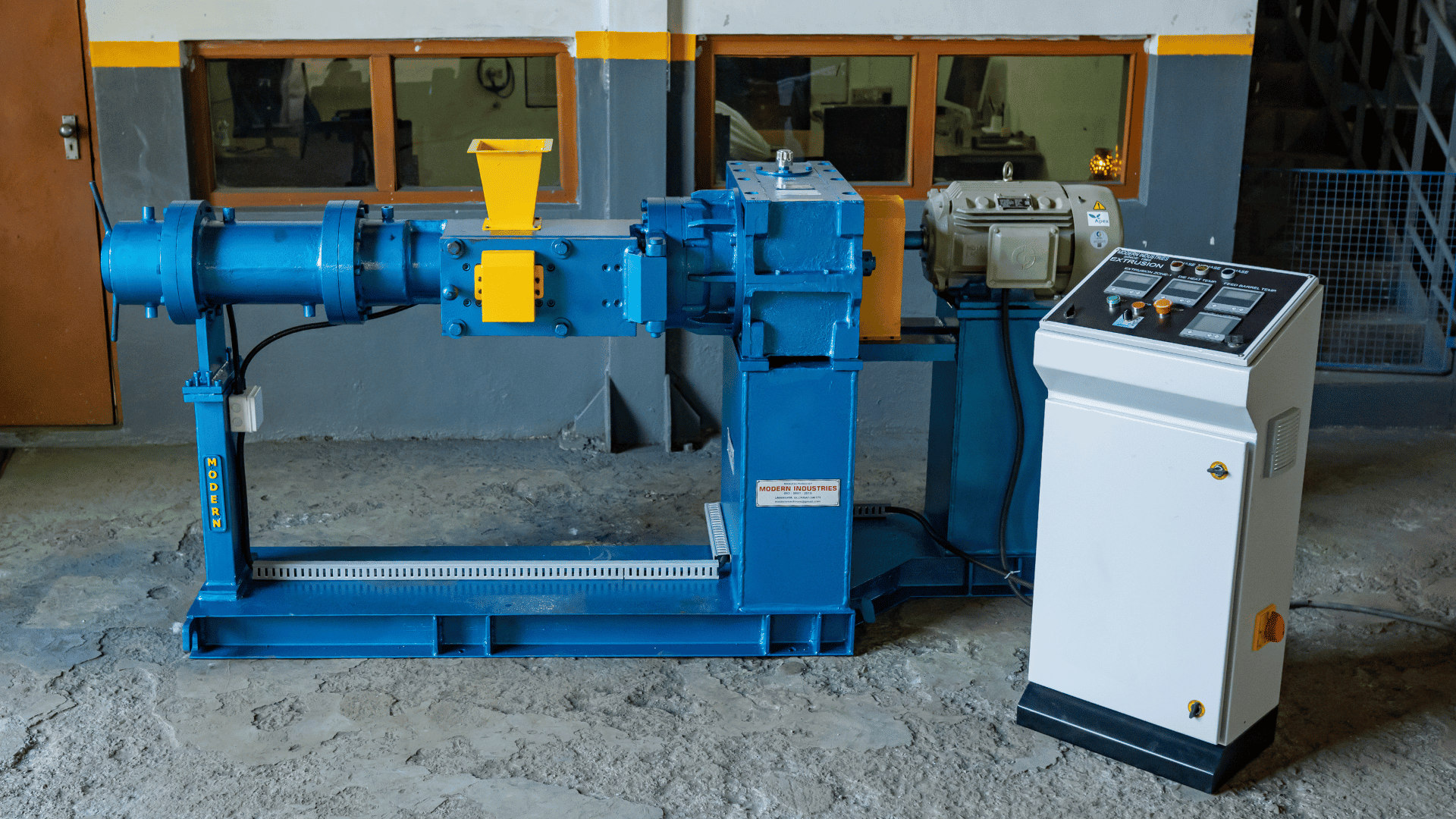

Cold Feed Rubber Extruder Manufacturer India — MI-CF-EXT Series
Modern Industries Cold Feed Rubber Extruder — 7 models from 45mm to 200mm screw diameter. L/D ratio 10:1 to 16:1. Output 40–2,400 kg/hr. TCU (Temperature Controlling Unit) temperature control on all zones. Built for precision extrusion of automotive seals, rubber hose, cable insulation, window gaskets, and continuous profiles.
What is a Cold Feed Rubber Extruder?
A cold feed rubber extruder processes room-temperature rubber compound fed directly into the hopper without pre-heating. The longer screw — L/D ratio 10:1 to 16:1 — performs three functions in a single pass: conveying the cold compound, plasticising it through controlled mechanical shear, and homogenising it before die entry. This multi-function screw design, combined with TCU (Temperature Controlling Unit) zone-by-zone temperature management, delivers the dimensional accuracy and surface consistency demanded by automotive, cable, and precision seal applications.
Cold feed extruders are the standard choice for applications where dimensional tolerances are critical — automotive door seals, window gaskets, cable insulation, hydraulic hose, and continuous precision profiles. The absence of a pre-heating step also simplifies the production line by eliminating the mixing mill warm-up feed stage.
★ MI-CF-EXT Series — Key Technical Highlights
TCU (Temperature Controlling Unit): Zone-by-zone temperature control — EXCLUSIVE to Cold Feed. Not available on hot feed or silicone extruder types.
L/D Ratio: 10:1 to 16:1 — longer screw for full plasticising, homogenising, and shaping in one pass.
Screw: Nitrided alloy steel / bimetallic coated — optimised for wear resistance with room-temperature compound.
Barrel: Bimetallic liner — superior wear resistance for high-shear cold compound processing.
Output: 40–2,400 kg/hr — the widest output range across all three extruder types.
Screw Speed: 6–60 RPM variable (6–50 RPM on 200mm model) — VFD controlled.
MI-CF-EXT Series — Full Specification Table
All specifications verified from Modern Industries engineering data.
| Model | Screw Dia (mm) | L/D Ratio | Motor (HP) | Output (kg/hr) | Screw Speed (RPM) | TCU Zones | Weight (kg) |
|---|---|---|---|---|---|---|---|
| MI-CF-EXT-45 | 45 | 10:1 | 15 | 40–60 | 6~60 | 2 | 800 |
| MI-CF-EXT-60 | 60 | 10:1 | 40 | 100–150 | 6~60 | 3 | 1,000 |
| MI-CF-EXT-75 | 75 | 12:1 | 60 | 150–200 | 6~60 | 3 | 1,200 |
| MI-CF-EXT-90 | 90 | 16:1 | 75 | 300–400 | 6~60 | 4 | 3,200 |
| MI-CF-EXT-120 | 120 | 16:1 | 150 | 600–800 | 6~60 | 4 | 5,200 |
| MI-CF-EXT-150 | 150 | 16:1 | 200 | 1,200–1,400 | 6~60 | 4 | 6,500 |
| MI-CF-EXT-200 | 200 | 16:1 | 300 | 2,000–2,400 | 6~50 | 4 | 12,000 |
TCU — Temperature Controlling Unit
The TCU (Temperature Controlling Unit) is the defining feature of the MI-CF-EXT Cold Feed Extruder series and is not available on Hot Feed or Silicone extruder models.
| TCU Feature | Description |
|---|---|
| Zone Control | Each barrel zone has an independent temperature controller — set point, actual temperature, deviation alarm |
| Cooling Circuit | Forced water cooling per zone — prevents compound scorch in high-shear processing regions |
| Heating | Ceramic band heaters with lower temperature settings than hot feed — precise, stable zones |
| Scorch Prevention | Real-time zone temperature monitoring prevents premature compound vulcanisation in the barrel |
| Dimensional Accuracy | Stable zone temperatures ensure compound viscosity is consistent at the die — tighter profile tolerances |
| Models 45-75mm | 2-3 TCU zones |
| Models 90-200mm | 4 TCU zones |
Construction & Materials
| Component | Specification |
|---|---|
| Screw | Nitrided alloy steel / bimetallic coated — high wear resistance for room-temperature compound processing |
| Barrel | Bimetallic liner — superior wear resistance, replaceable liner for extended barrel life |
| Head | Alloy tool steel with integrated temperature control — ensures stable compound at die entry |
| Drive | Heavy-duty helical gearbox + AC motor + VFD — variable speed 6–60 RPM (6–50 RPM on 200mm) |
| TCU | Temperature Controlling Unit — independent per-zone water-cooled temperature management |
| Heating | Ceramic band heaters — lower operating temperature than hot feed for controlled shear heating |
| Frame | Heavy-duty welded steel base — foundation-mounted, grouted and bolted |
Temperature Zones — MI-CF-EXT Series
Cold feed extruders use TCU-controlled temperature zones. Zone count increases with screw diameter. Each zone is independently set and monitored.
| Zone | Location | TCU Control | Function |
|---|---|---|---|
| Zone 1 | Feeding Zone | Yes | Regulates cold compound intake temperature — prevents early scorch at feed throat |
| Zone 2 | Extrusion Zone | Yes | Primary plasticising and homogenising zone — highest shear region |
| Zone 3+ | Additional Extrusion Zones | Yes | Extended processing on 75mm+ models — progressive compound conditioning |
| Zone 4 | Die Head Zone | Yes | Precise compound temperature at die entry — critical for dimensional accuracy |
| Zone 5 | Screw | Water-cooled | Internal screw cooling — prevents compound adhesion and overheating of screw core |
Applications
Automotive Rubber Seals & Gaskets
Cold feed extruders are the standard machine for EPDM automotive door seals, window run channels, bonnet seals, and boot seals. The TCU-controlled temperature stability ensures the compound viscosity at the die is consistent — producing seal profiles with dimensional tolerances tight enough for automotive assembly line fit.
Cable & Wire Insulation
Rubber insulation for electrical cable — including NBR, EPDM, and silicone blends — requires precise dimensional control and void-free compound at the die. Cold feed extruders with 4-zone TCU control on 90mm–150mm models are standard for cable jacket and insulation extrusion.
Rubber Hose — Precision & High-Pressure
Hydraulic hose, refrigerant hose, and high-precision automotive coolant hose require dimensional accuracy that hot feed cannot consistently achieve. Cold feed on MI-CF-EXT-75 to MI-CF-EXT-120 is standard for these applications.
Window & Construction Gaskets
EPDM window gaskets for residential and commercial glazing systems require consistent cross-section over long continuous runs. Cold feed extrusion with TCU control maintains the dimensional consistency required for multi-point compression seals.
Continuous Technical Profiles
Any technical rubber profile requiring tight dimensional tolerances, smooth surface finish, and compound homogeneity over long continuous production runs — solid tyres, conveyor belt edge profiles, engineering rubber components — is a cold feed application.
Compatible Rubber Types
| Rubber Type | Notes |
|---|---|
| EPDM | Primary cold feed compound — door seals, weatherstripping, automotive applications |
| Nitrile (NBR) | Oil-resistant seals, hose, and industrial profiles |
| Neoprene (CR) | Flame-resistant gaskets and hose |
| Butyl (IIR) | Gas-impermeable profiles and hose |
| Natural Rubber (NR) | Solid tyre compound, large section profiles |
| SBR | General purpose technical profiles |
| Hard Compounds | Solid tyre, high-hardness EPDM, reclaim rubber blends |
Frequently Asked Questions
What makes a cold feed extruder different from a hot feed extruder?
A cold feed extruder processes room-temperature compound directly — no mixing mill pre-heating required. The longer L/D screw (10:1–16:1 vs 6:1 on hot feed) plasticises, homogenises, and conveys the compound in one pass. The key differentiator is TCU (Temperature Controlling Unit) temperature control per zone — giving precise dimensional accuracy. Hot feed is better for high-output large-section profiles; cold feed is better for dimensional precision, surface quality, and hard compounds.
What is TCU temperature control on cold feed extruders?
TCU stands for Temperature Controlling Unit. On the MI-CF-EXT series, each barrel zone has an independent TCU controller with water-cooled cooling circuits, ceramic band heaters, and temperature deviation alarms. This zone-by-zone control ensures the compound temperature is stable and consistent throughout the barrel — preventing compound scorch, improving dimensional accuracy, and maintaining surface quality. TCU is exclusive to the cold feed extruder series.
Which MI-CF-EXT model is best for automotive EPDM door seal extrusion?
Automotive door seal extrusion typically uses 75mm–120mm cold feed machines with 3–4 TCU zones — MI-CF-EXT-75, MI-CF-EXT-90, or MI-CF-EXT-120 depending on profile cross-section and required output. Contact our team with your seal profile dimensions and linear output requirement for a specific model recommendation.
Can cold feed extruders process hard rubber compounds and reclaim rubber?
Yes. Cold feed extruders with bimetallic barrel liners and longer L/D ratios are specifically designed for hard compounds, high-filler formulations, and reclaim rubber blends that would otherwise require extended pre-warming. The mechanical shear of the longer screw plasticises these compounds effectively at room temperature.
What is the maximum output of the MI-CF-EXT series?
The largest model — MI-CF-EXT-200 (200mm screw, 300 HP) — delivers 2,000–2,400 kg/hr. This is the highest output rate across all three Modern Industries extruder types. Actual output depends on compound viscosity, L/D ratio, die configuration, and TCU zone temperatures. Contact us with your compound specification for confirmed output.