


Industrial Rubber Goods Manufacturing Machine India — IRG Machinery
Hydraulic presses, calender machines, mixing mills, dispersion kneaders, and extruders for industrial rubber goods manufacturers — dock fenders, anti-vibration mounts, rubber linings, buffers, industrial mats, and engineered rubber mouldings. Supplied from GIDC Umbergaon, Gujarat.
Core Industries
Countries
Industrial Rubber Goods — The Broadest Rubber Manufacturing Segment
Industrial Rubber Goods (IRG) is the umbrella term for the vast range of engineered rubber products used across heavy industry, infrastructure, marine, mining, and general engineering applications. Every sector of the Indian economy uses industrial rubber goods: ports use dock fenders, factories use anti-vibration mounts and conveyor rollers, chemical plants use rubber-lined tanks and pipes, construction sites use rubber buffers and bearing pads, and power plants use insulating rubber components.
Because IRG spans such a wide product range, IRG manufacturers typically need the most versatile set of rubber processing machines of any segment — combining mixing and compounding equipment, large-tonnage hydraulic presses for heavy mouldings, calender machines for sheet linings, and extruders for profile production.
Modern Industries supplies the complete machinery range for IRG manufacturers from GIDC Umbergaon, Gujarat — configured to the specific compound, tonnage, and dimensional requirements of each IRG product category.
Machines Used in Industrial Rubber Goods Manufacturing
IRG production typically requires more machine types than any other rubber segment — because the product range is so wide.
MI-HP-12 to MI-HP-48 (37T–600T)
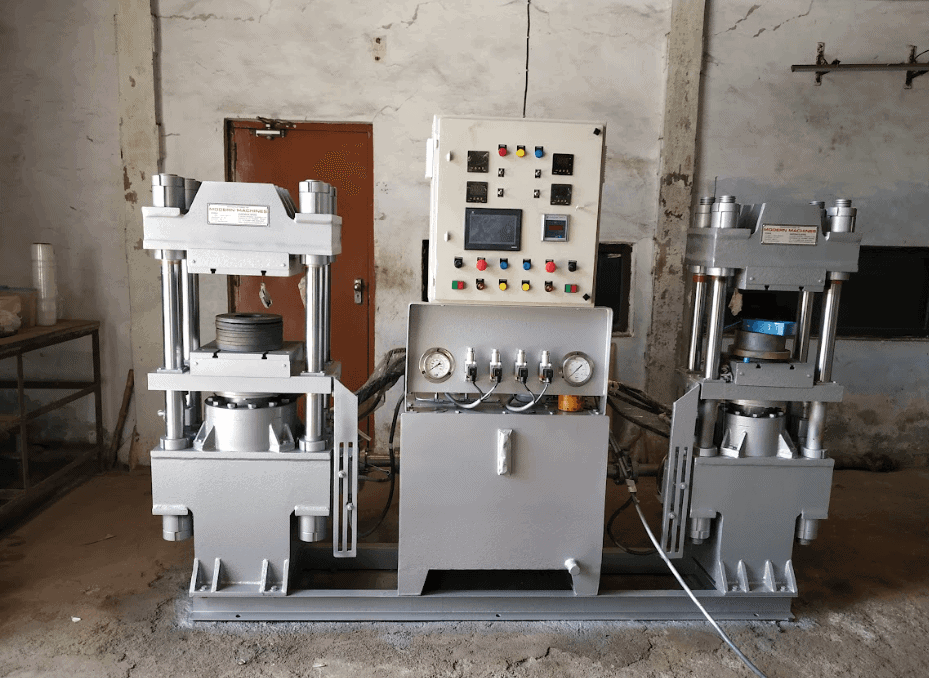
Hydraulic Press
IRG Application: Compression moulding of heavy industrial rubber components
Typical Product Made: Dock fenders, anti-vibration mounts, rubber buffers, bearing pads, industrial seals
MI-CL-14×42 to MI-CL-24×72
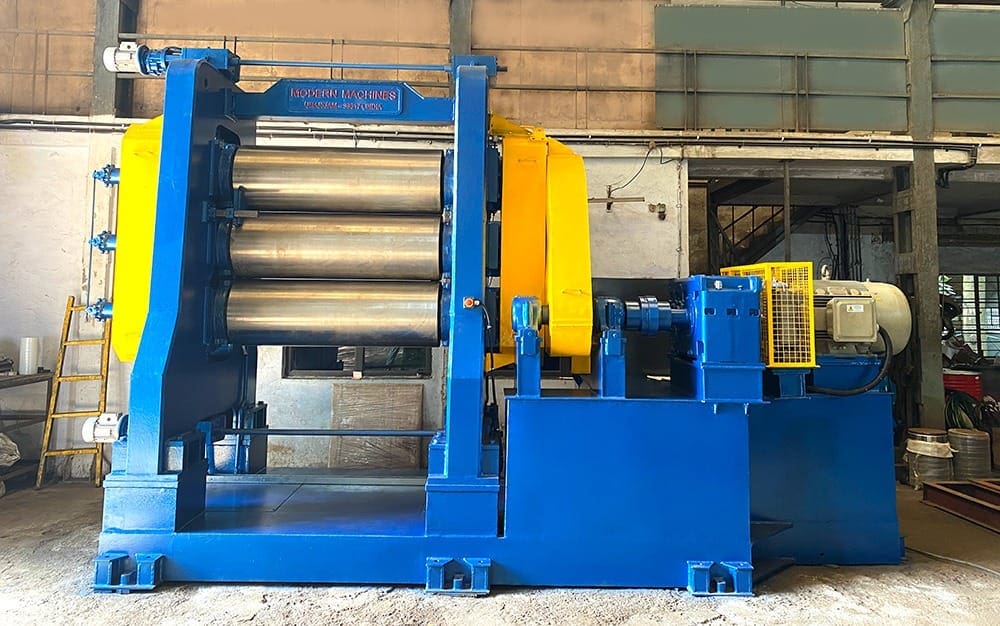
Calender Machine
IRG Application: Rubber sheet production for lining, matting, and large-format IRG
Typical Product Made: Tank linings, rubber flooring, industrial mats, large gasket blanks, flat pad material
MIKH-4 to MIKH-7 (35L–100L)
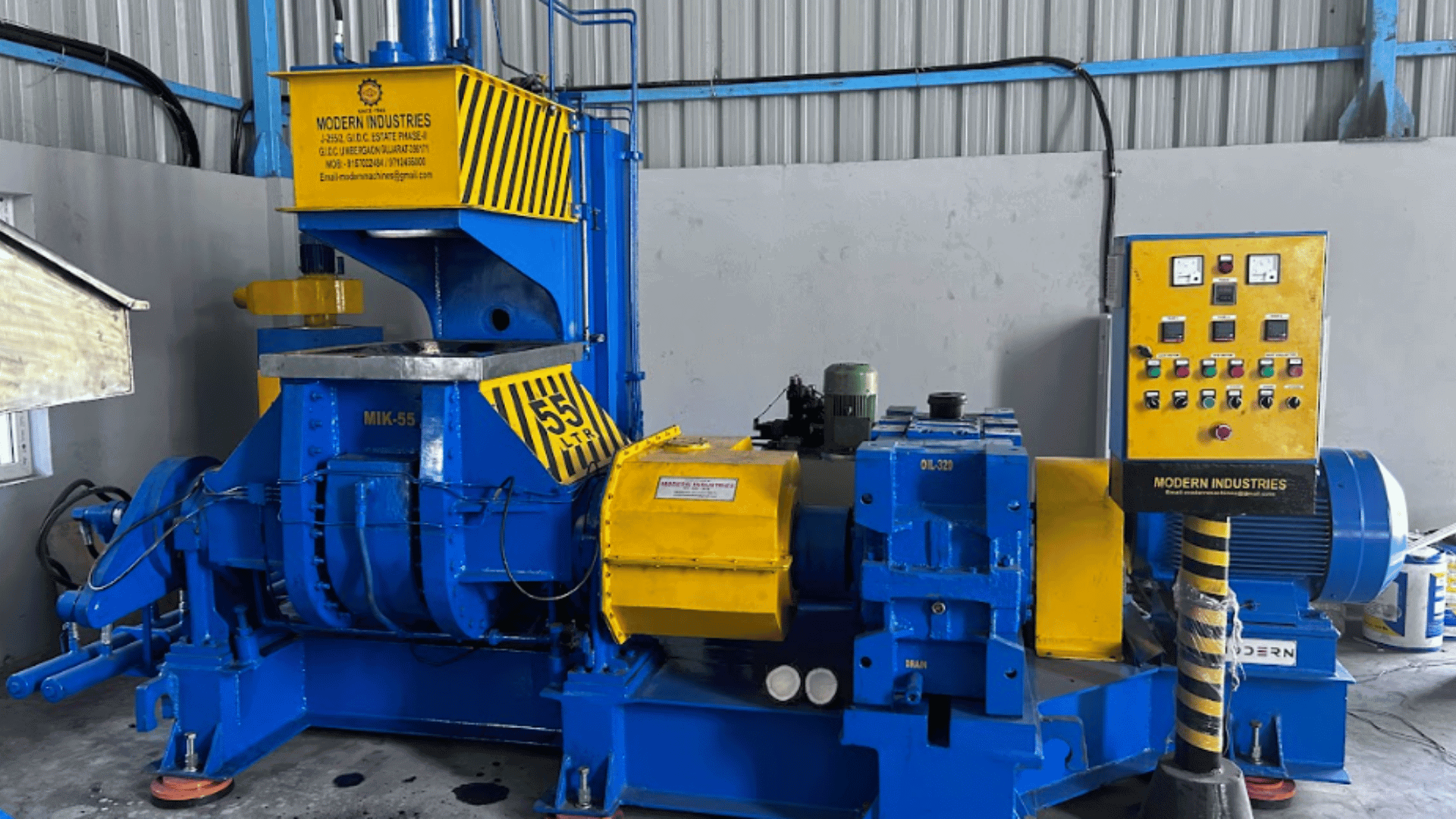
Dispersion Kneader
IRG Application: High-filler compound mixing for industrial compound specifications
Typical Product Made: All heavy industrial rubber compounds — NR, SBR, EPDM for structural IRG products
M3–M6 AFB
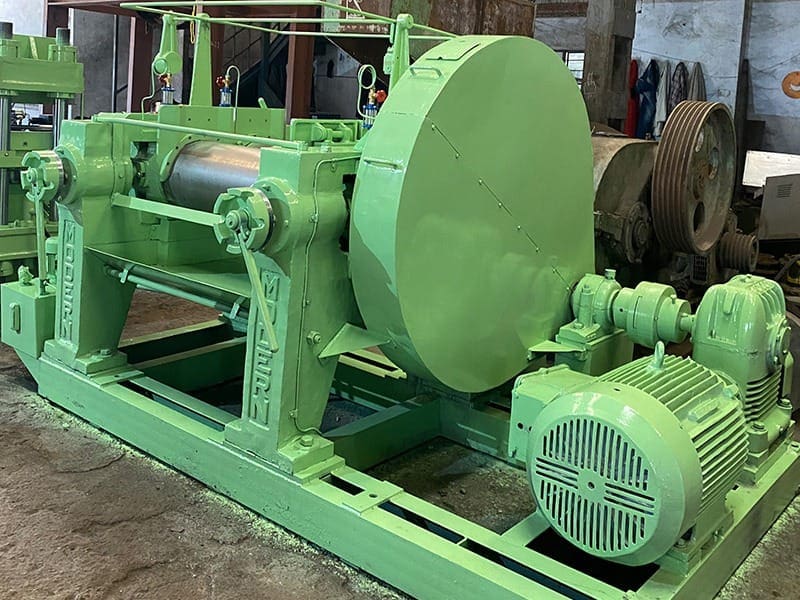
Rubber Mixing Mill
IRG Application: Compound batching, sheeting, and colour compound preparation
Typical Product Made: Upstream compound prep for all IRG moulding and calendering operations
Extruder series
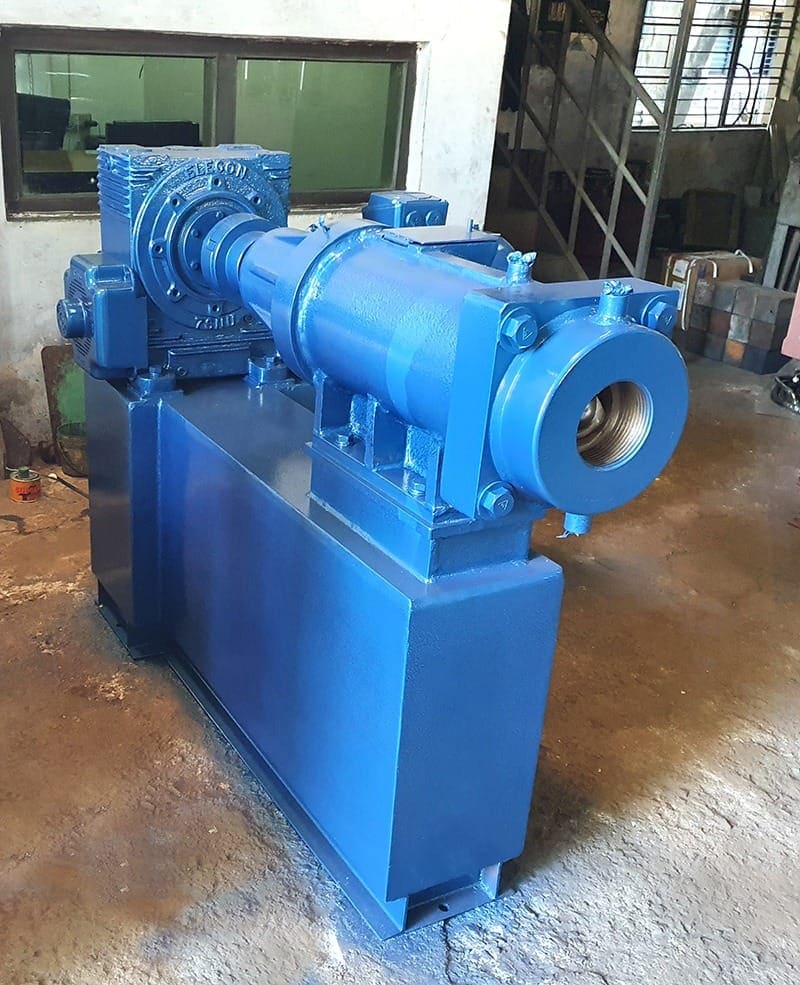
Hot / Cold Feed Extruder
IRG Application: Industrial rubber profiles, hose, and continuous section production
Typical Product Made: Industrial hose, rubber edging, sealing profiles, extrusion-moulded products
Industrial Rubber Goods — Product Categories & Machine Requirements
Anti-Vibration Mounts & Pads
Anti-vibration rubber products are among the highest-volume IRG products in India — used under industrial machinery, generators, HVAC equipment, railway line supports, and structural isolation pads in buildings and bridges. The rubber must provide the right combination of dynamic stiffness, compression set resistance, and fatigue life under continuous vibration loading.
Natural rubber (NR) or NR/SBR blends at 40–70 Shore A are the standard compound for anti-vibration mounts. The Hydraulic Press (MI-HP-24 to MI-HP-32, 250T–400T) mould the component from pre-cut compound blanks. For large structural isolation pads, the MI-HP-36 to MI-HP-48 (500T–600T) with large platens are required.
Dock Fenders & Marine Rubber Products
Dock fenders protect vessel hulls and quay structures from impact during berthing. They are among the largest compression-moulded rubber products in the IRG segment — cylindrical or D-section profiles weighing hundreds of kilograms. The compound must absorb repeated high-energy impacts without catastrophic failure — requiring high-resilience NR compound with controlled compression deflection characteristics.
Large dock fenders require MI-HP-40 to MI-HP-48 (1000×1000 mm to 1200×1200 mm platens, 600T) for single-shot moulding. For very large fenders, the Window Type press configuration allows unrestricted mould access from all sides.
Rubber Linings for Chemical &
Slurry Applications
Rubber-lined tanks, pipes, pump casings, and agitators are used extensively in chemical processing, mining slurry handling, and paper mill stock processing — wherever the industrial fluid would corrode or erode an unprotected metal surface. Natural rubber and EPDM compounds provide the primary resistance to acid, slurry abrasion, and temperature cycling in lined equipment.
The Calender Machine (MI-CL-14x42 to MI-CL-24x72) produces the rubber lining sheets — typically 3–8 mm thick — in widths matching the tank diameter or pipe circumference. Wide, void-free sheets are critical for lining adhesion; any air entrapment between the lining sheet and the metal substrate creates a blister that grows under service conditions and eventually causes lining failure.
Rubber Buffers & Engineering Mouldings
Industrial rubber buffers, bumpers, bearing pads, and general engineering mouldings are the backbone product of the IRG sector — produced in high volumes by small and medium rubber goods manufacturers across India. These products cover a huge range of shapes, sizes, and compound specifications, all requiring compression moulding in hydraulic presses.
The MI-HP range from 37T (MI-HP-12) to 600T (MI-HP-48) covers the full size spectrum of industrial rubber mouldings — from small engineering buffers to large structural bearing pads. PLC-controlled cure cycles with data recording support quality documentation requirements for infrastructure and engineering procurement.
Industrial Rubber Hose & Profiles
Industrial rubber hose — large-bore suction and delivery hose, dredging hose, and slurry transfer hose — and large-section rubber profiles are produced by Hot Feed Extruders. These are typically higher-output, larger-diameter products than the automotive hose produced on cold feed lines. The Hot Feed Extruder handles the high-viscosity, large-volume compound batches required for industrial hose production.
IRG Manufacturing Process — From Compound to Finished Product
Compound formulation
Compound specification selected per product requirement — NR for anti-vibration and fenders, EPDM or NR for linings, SBR/NR blends for buffers and mats.
Internal mixing
Dispersion Kneader (MIKH-4 to MIKH-7) for high-filler or large-batch compound mixing. Ensures uniform filler dispersion in structural IRG compounds.
Open mill batching
Mixing Mill (M4–M6 AFB) sheets the compound to required gauge for press feed or calender feed.
Moulding (Hydraulic Press)
Pre-cut compound blanks placed in mould cavity. MI-HP Series press closes at programmed temperature, pressure, and cure time. PLC data recording for quality traceability.
Calendering (Linings & Mats)
MI-CL Series calender produces wide-format lining sheets and mat blanks at controlled thickness.
Extrusion (Hose & Profiles)
Hot Feed Extruder produces continuous industrial hose and large-section rubber profiles.
Quality inspection
Dimensional check, Shore hardness, compression set, visual inspection for surface defects. Samples verified against compound approval standard.
Press Selection for Industrial Rubber Goods — Tonnage & Platen Guide
Typical Size Range: 50–200 mm OD
Press Model: MI-HP-12 to MI-HP-18
Tonnage: 37T–150T
Typical Size Range: 100–400 mm
Press Model: MI-HP-20 to MI-HP-28
Tonnage: 200T–300T
Typical Size Range: 300–800 mm square
Press Model: MI-HP-28 to MI-HP-36
Tonnage: 300T–500T
Typical Size Range: 500–1,200 mm square
Press Model: MI-HP-36 to MI-HP-48
Tonnage: 500T–600T
Typical Size Range: 500–800 mm OD
Press Model: MI-HP-36 to MI-HP-40
Tonnage: 500T–600T
Typical Size Range: 800–1,500 mm OD
Press Model: MI-HP-40 to MI-HP-48 (Window Type)
Tonnage: 600T — special config
Why IRG Manufacturers Choose Modern Industries
- Widest press range in the MI-HP portfolio — 37T to 600T with platens from 300×300 mm to 1200×1200 mm. IRG manufacturers do not need different suppliers for different product sizes — one machine range covers all
- Window Type press configuration available — essential for large dock fenders and structural rubber products where the mould must be accessed from multiple sides during loading and unloading
- Complete upstream line from one supplier — Kneader + Mixing Mill + Calender + Press + Extruder. All supplied from GIDC Umbergaon with compatibility guaranteed between machines
- PLC cure data recording on all MI-HP presses — infrastructure and engineering procurement increasingly requires batch traceability documentation for rubber components in structural applications
- 50 years of rubber machinery manufacturing experience — serving IRG manufacturers across India and in 19+ export countries, with service engineers and spare parts for the full product range
Frequently Asked Questions — Industrial Rubber Goods Machinery
What machines are needed to set up an industrial rubber goods manufacturing plant?
A complete IRG manufacturing setup typically requires: a Dispersion Kneader (MIKH Series) for compound mixing, a Rubber Mixing Mill (M4–M6 AFB) for batching and sheeting, a Hydraulic Press (MI-HP Series — tonnage selected by product size) for compression moulding, and a Calender Machine (MI-CL Series) for rubber lining and sheet production. Modern Industries supplies all four machines and can specify the complete plant layout based on your product range and production capacity target.
What hydraulic press tonnage is needed for dock fender moulding?
Medium dock fenders (500–800 mm OD) require the MI-HP-36 to MI-HP-40 (500T–600T, 910×910 mm to 1000×1000 mm platen). Large dock fenders (800 mm OD and above) require the MI-HP-40 to MI-HP-48 (600T, up to 1200×1200 mm platen) in Window Type configuration for unrestricted mould access. For very large custom dock fenders exceeding standard platen sizes, custom press specifications are available on request.
What rubber compound is used for anti-vibration mounts?
Anti-vibration mounts are typically produced from Natural Rubber (NR) or NR/SBR blends at 40–70 Shore A hardness, depending on the required dynamic stiffness. NR is preferred for its superior resilience and fatigue resistance under dynamic loading. EPDM is used where ozone and weathering resistance is required (outdoor installations). The compound is prepared on the Mixing Mill (M4–M6 AFB) and moulded in the Hydraulic Press (MI-HP-20 to MI-HP-32, 200T–400T).
What calender machine width is needed for rubber tank lining?
Tank lining sheet width depends on the tank diameter. The MI-CL-14×42 (39″ working width) suits tanks up to approximately 1,000 mm diameter. The MI-CL-18×54 (51″ width) covers tanks up to 1,300 mm. The MI-CL-24×72 (69″ width) handles large tanks and vessels up to 1,750 mm diameter — with the lining sheet applied in a single width without jointing. For irregular-shaped vessels or very wide surfaces, multiple sheet widths are lapped and bonded on-site.
Can Modern Industries supply machinery for rubber lining production for chemical plants?
Yes. Modern Industries supplies Calender Machines (MI-CL Series) for rubber lining sheet production and Mixing Mills (AFB Series) for compound preparation. The MI-CL-18×54 and MI-CL-24×72 produce wide, void-free lining sheets in natural rubber, EPDM, and NBR compounds. For chemical plant lining applications requiring specific chemical resistance certifications, compound formulation recommendations are provided as part of our pre-sale engineering consultation.